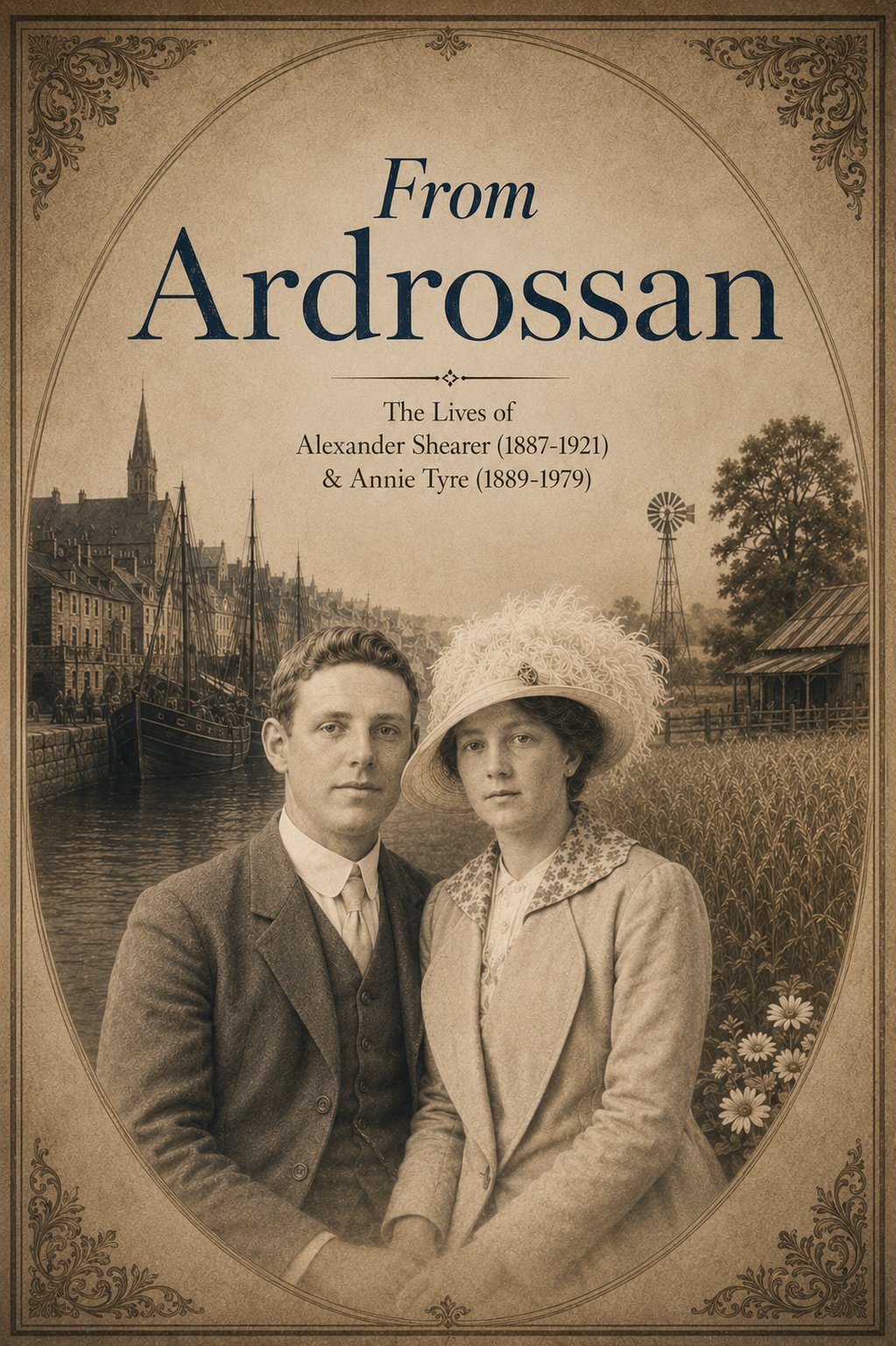
❧
It is November 1903, Ardrossan, Ayrshire. A grey morning on the Firth of Clyde. The tide is out, and the smell of weed and coal-smoke hangs low over the harbour.
Up on the slip the riveters have started, and the clank of iron on iron rolls across the town like a slow bell. Steam drifts off the water. A coaster works out past the breakwater, deep with cargo, and the gulls go up after her in a white cloud.
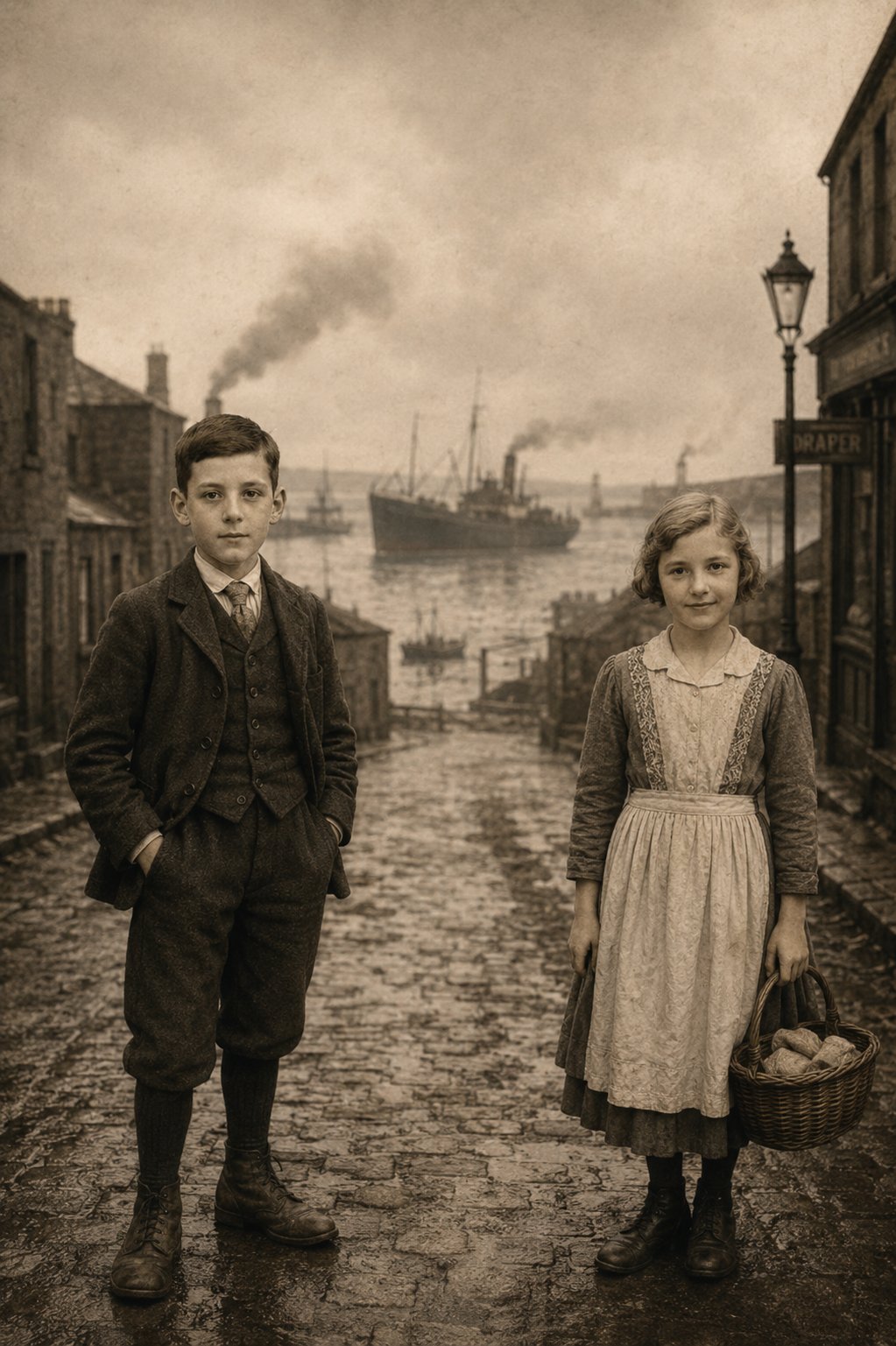
On Harbour Place a boy steps out into the lane - a ship-carpenter's son, all elbows and a good clear singing voice. A few streets over, on Alexander Place, a draper's daughter is sent to the shop for thread. The two back greens very nearly touch.
Neither of them knows that one day they will stand together on a wharf on the far side of the world, in the dust and the heat, and call a paddock by the name of this cold grey town. For now there is only the harbour, the coal-smoke, and the sea - which, for a working man of Ardrossan, was always the road out.
❧
Introduction
This is the story of Alexander Shearer (1887-1921) and Annie Barclay Tyre (1889-1979) - two children of the Scottish harbour town of Ardrossan who grew up a street apart, close enough that their backyards met, and who built a life together on the far side of the world, in the wheat-and-wool country of the New South Wales Castlereagh. He was a ship-carpenter's son who went to sea; she was a draper's daughter trained as a children's nurse. They married in Sydney in 1914. He died young, in 1921, before his youngest child was born. She lived on for another fifty-eight years - going home to Scotland and coming back again, keeping a shop, marrying a second time, and outlasting nearly everyone in this book.
It is told from the family's own documents, from the newspapers, and from the records - a marriage certificate, a crew list, an old soldier's letter, a probate file down to the last chisel - and from the memory of their youngest daughter, Lex.
A note on the story
We can't be sure of everything that happened in these lives. But with careful research, the surviving evidence and a feel for the times, we can work out the shape of the story - and this one is theirs. Where the record is firm, we say so. Where something is only likely, we say that too. Family tradition is named as tradition. Any drawing here is an artist's reconstruction, never a photograph. Nothing in it is invented. The small raised numbers through the text point to the numbered References at the end.
Chapter One · 1887-1909
A Shipbuilding Family
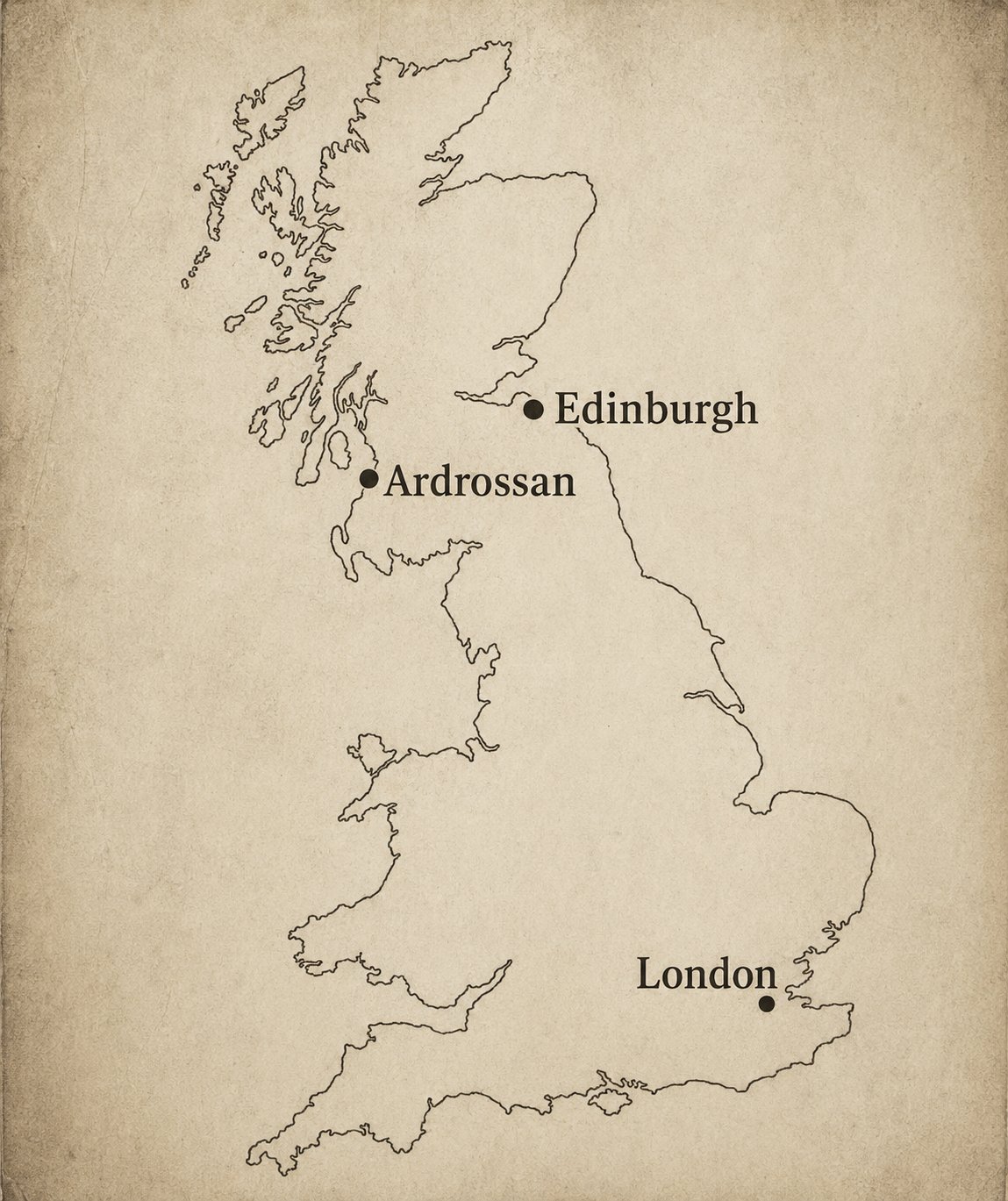
Ardrossan in the 1880s was a working harbour on the Ayrshire coast, a place of slipways and coal-staithes where the produce of industrial Scotland went out to Europe and North America, and where the sea was the natural road for any man who wanted to get on. It was into this town, on 13 December 1887, that Alexander Shearer was born, at 9 Harbour Place, the son of Alexander Shearer, a ship-carpenter journeyman, and his wife Margaret, née Wylie.1
To understand the Shearers you have to understand the town, because the two were made of the same stuff. Ardrossan had not grown up by accident on the Firth of Clyde; it had been built on purpose - from a foundation stone laid in 1806 - to be a harbour, and by the 1840s it was one, with two great tidal basins, stone quays and shipbuilding slips. Coal and pig-iron went out from it to Europe and across the Atlantic, and from 1825 ships were built along the harbour - one yard carrying a name this family would one day carry across the world: Barr & Shearer, established in 1842. It was a crowded, churchgoing, respectable place of Presbyterian kirks and tenement streets, where a working household counted gas light a small luxury. That was the world the ship-carpenter's son was born into - and the reason the road ahead for such a boy always ran down to the water.90
He was one of a large family - at least eight children - and the household moved about the burgh's tenement streets the way working families did: a close at Bute Place, then rooms at 214 Glasgow Street.2 The trade Alexander would one day carry across the world, carpentry, was his father's before him. But that inheritance came early and hard. In 1901, when Alexander was thirteen and still a scholar, his father died of phthisis - the tuberculosis of the crowded industrial west.3
His widowed mother did what a capable Ardrossan woman did: she took on work that would keep the family respectable and fed. Margaret Shearer kept the Sub Post Office on Glasgow Street - when the local paper wrote up her son's success years later, it placed him plainly as "son of Mrs Shearer, Post Office, Glasgow Street, Ardrossan."4 It is a small, telling detail: the boy who went to sea came from a household that, after the father's death, was held together by his mother behind a Post Office counter.
A short walk away, on Alexander Place, lived the Tyres. James Tyre junior was a draper, a shopkeeping man with premises of his own, and his daughter Annie Barclay Tyre had been born there on 23 December 1889 - almost exactly two years after Alexander.5 The Tyre household moved about the better streets of the town - Glasgow Street, then Seton Street - and by family account they were comfortable, the sort of people who kept a nanny.6 Annie was trained for a profession, as a children's nurse7 - a skill that would, in time, cross the world with her. Of her girlhood the record is otherwise thin; but the shape of it is clear enough - a draper's daughter, brought up a little above the harbour streets, who knew the ship-carpenter's son two doors and a world away.
Alexander, for his part, had a voice. He sang with the Ardrossan Musical Society and trained under a local teacher, J. W. Blythe8; in 1908 he performed in a local operetta.9 And in 1909 he took a step into the life of the town that would echo far beyond it: he was raised a Master Mason in Lodge Saltcoats & Ardrossan No. 320.10 It seemed a small thing - a young tradesman joining his brethren. It was not. That single tie would reach forward across thirty years and two oceans to shape the childhoods of daughters not yet born.
His father had been a ship's carpenter; the town built ships; and the way ahead for such a boy was the sea. Alexander followed it, signing on with the Glasgow firms whose vessels were known, with grim sailor's affection, as the "unlucky" Loch Line.11 It would live up to its name.
Chapter Two · about 1907-1910
To Sea on the Loch Line
❧
It is 27 April 1910, off the New South Wales coast. The worst of it has passed. All night the gale has been at them, and at first light the Loch Katrine is a wreck that still floats - her mainmast gone over the side in a cat's-cradle of rigging, the deck awash, every loose thing aboard trying to kill somebody.
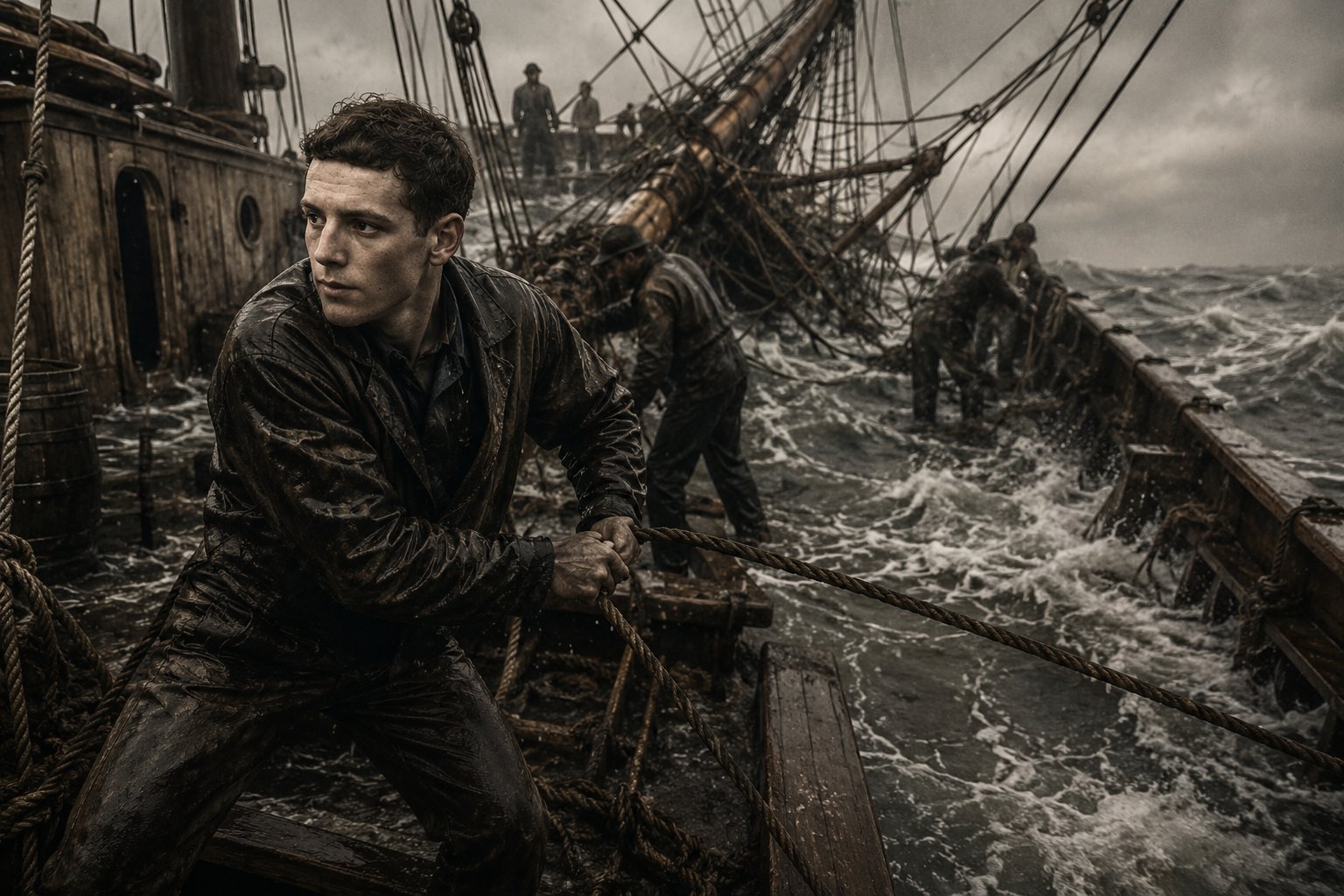
A boat has put off to find help; the rest of them are left to hold the ship together until it comes. There is no time to be frightened. There is only the next job, and the one after that.
"On that spar - now!" the mate bawls, the words half torn away by the wind. Alex is already moving.
Alex gets a line on a swinging spar before the roll can throw it, takes a turn, eases, makes fast. Watch your hands. The ship lifts and drops, lifts and drops. A man near him swears, steadily, under his breath, like a prayer that has worn smooth.
For one moment, hauling wet rope with the salt stinging his eyes, Alex lets himself think the whole of it at once: a broken ship, a strange coast, and himself a long, long way from the Firth of Clyde.
Then a sea comes green over the rail, cold as the grave, and there is no more thinking - only the rope, and his two hands, and holding on.
❧
Alexander signed as an ordinary seaman on the barque Loch Katrine, one of the Loch Line's tall sailing ships still working the long routes in the last age of sail.11 What matters in his story is not the romance of it but one particular voyage - the one that brought him to Australia, and which was no ordinary passage at all.
To go to sea on the Loch Line about 1907 was to step into a trade the world had already begun to leave behind. Steam had taken the mails, the passengers and the paying cargo; the tall square-riggers hung on only where time did not matter and cheapness did - hauling coal, grain and wool on the long, slow routes to the far side of the world. A boy who signed one of them learned his seamanship the old, hard way, on ships that were themselves relics: months at a stretch out of sight of land, the whole southern leg run deep in the Roaring Forties for the sake of speed. It was a young man's world, poorly paid and genuinely dangerous, and it was closing even as Alexander entered it. That is the trade he gave his early twenties to - and it set him down, by accident, in the country that kept him.91
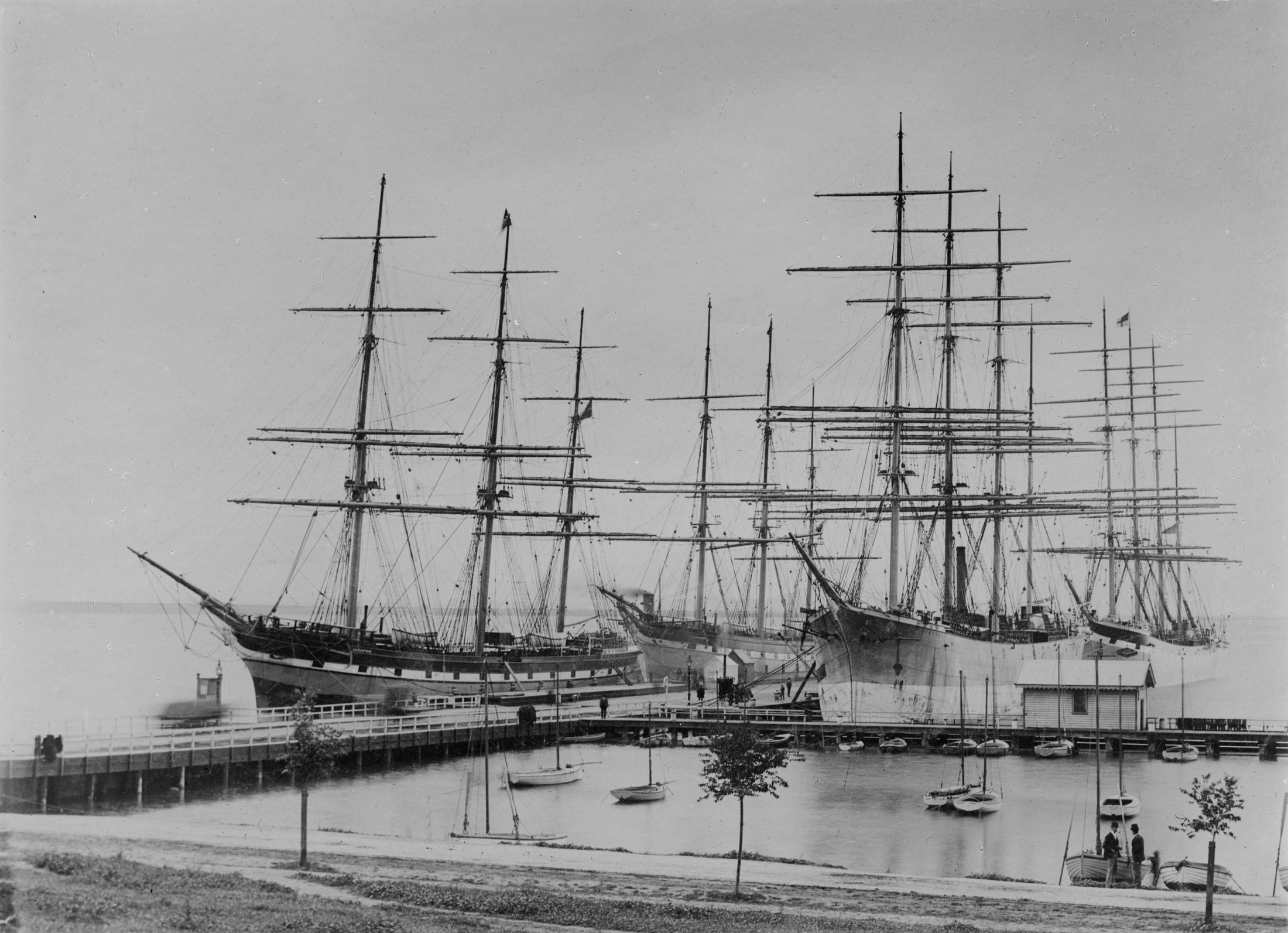
On 27 April 1910 the Loch Katrine was caught in a gale off Cape Perpendicular, on the New South Wales coast, and dismasted. Crippled, she was taken in tow and brought into Sydney, where she anchored in Athol Bight on 10 May 1910.12 So Alexander Shearer's first sight of the country that became his home was from the deck of a broken ship being dragged to safety - a documented, dramatic entrance that, as much as anything, decided the rest of his life. He had not come out to stay; but he was here.
The "unlucky" Loch Line
By the time Alexander went to sea, steam had taken the passengers and most of the trade - but the Loch Line of Glasgow kept sending its tall square-rigged sailing ships out to Australia all the same, one slow round voyage a year, and from about 1900 it ran consistently at a loss.11 Its ships drove far south into the Roaring Forties, the belt of gale-force westerlies that circles the bottom of the globe, on the fast and dangerous Great Circle track past the great capes - a region of huge seas and drifting ice where a small error in navigation could end everything. The line earned its grim nickname honestly: across its life a striking number of its ships were dismasted, wrecked or lost outright. Alexander's own ship, the Loch Katrine, was dismasted off the New South Wales coast in April 1910 - which is how he first came to Australia at all.12
Chapter Three · 1910-1914
Coonamble: Alex Builds a Life
❧
It is 26 July 1914, Sydney wharf. He is early. Of course he is early. He arrived early with brother Hugh two days ago.
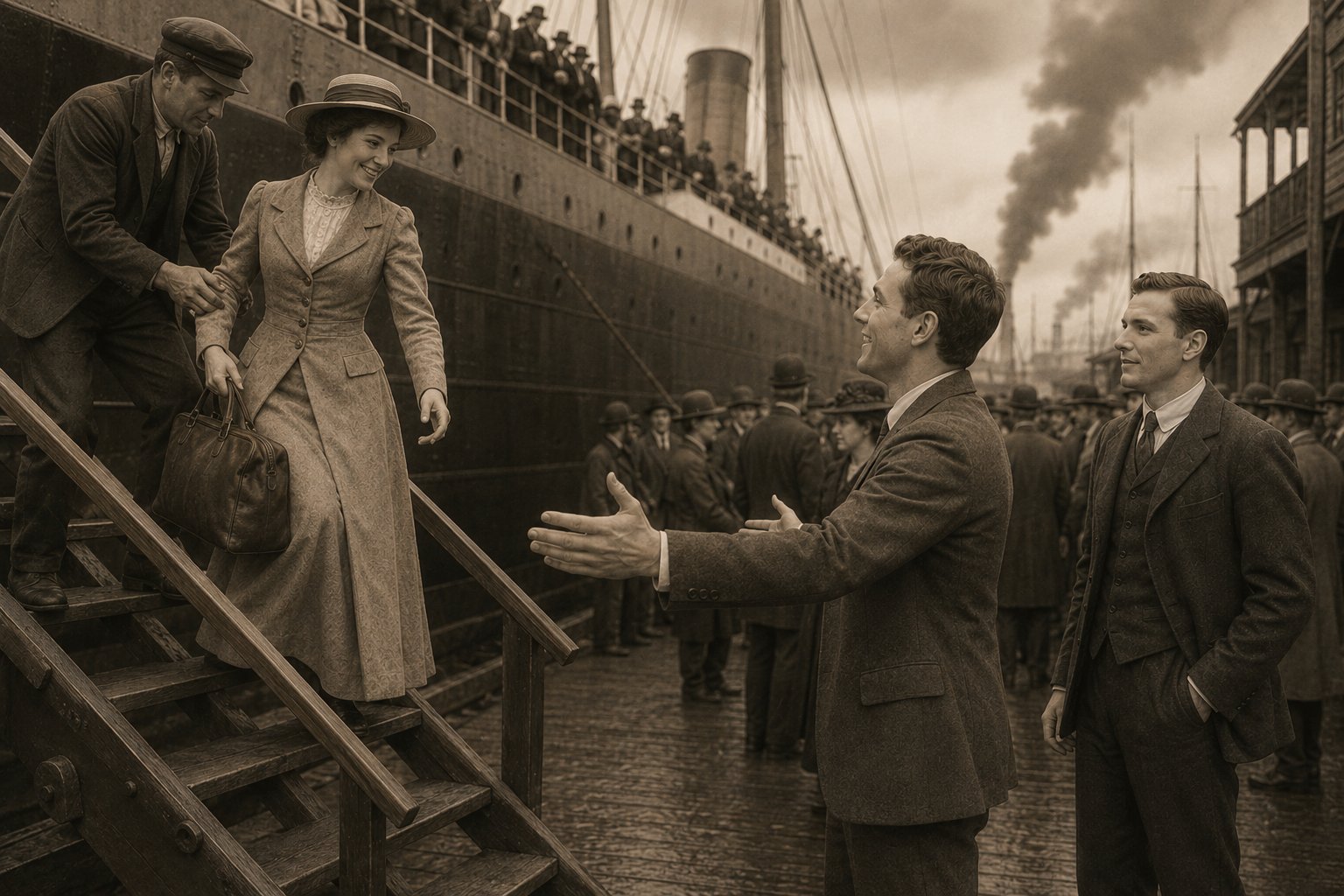
The steamer is warping in now, and Alex stands at the rail of the wharf in his good suit, scanning the line of faces coming down off the ship.
Four years ago he came into this harbour on a wreck. Now he has chosen to stay, gone all the way home to Scotland and back again - all for this one moment: will his girl from Alexander Place still want him, and will she want the hard dry land he is offering her instead of the green Firth of Clyde.
The gangway goes down. The passengers begin to come, and for a moment there are too many of them, and his heart goes sideways.
Then he sees her. Annie, at the top of the gangway, looking for him in the crowd. She finds his face.
And Alex knows - before she has said a single word, before she has set a foot on Australian ground - he knows it is going to be all right.
❧
From Sydney, Alexander went inland to the Castlereagh, to the Coonamble district, and took up the trade he knew. The 1913 electoral roll has him there as a carpenter, in Namoi Street.13 He was, by every sign, a man getting on: skilled, sober, well-liked.
The country Alexander went up into was itself a made thing, and a young one. The Castlereagh districts around Coonamble and Mendooran had been thrown open under the closer-settlement schemes that broke the old squatting runs into selections a working family could take up, and the railway had followed - so a tradesman arriving in the 1910s came into a wheat-and-wool country still building itself: new farms and fences, new houses, new halls and stores in the railway towns. It was exactly the place for a skilled, sober man with a trade in his hands; a carpenter could hardly fail to find work in a district that was, quite literally, going up around him.81
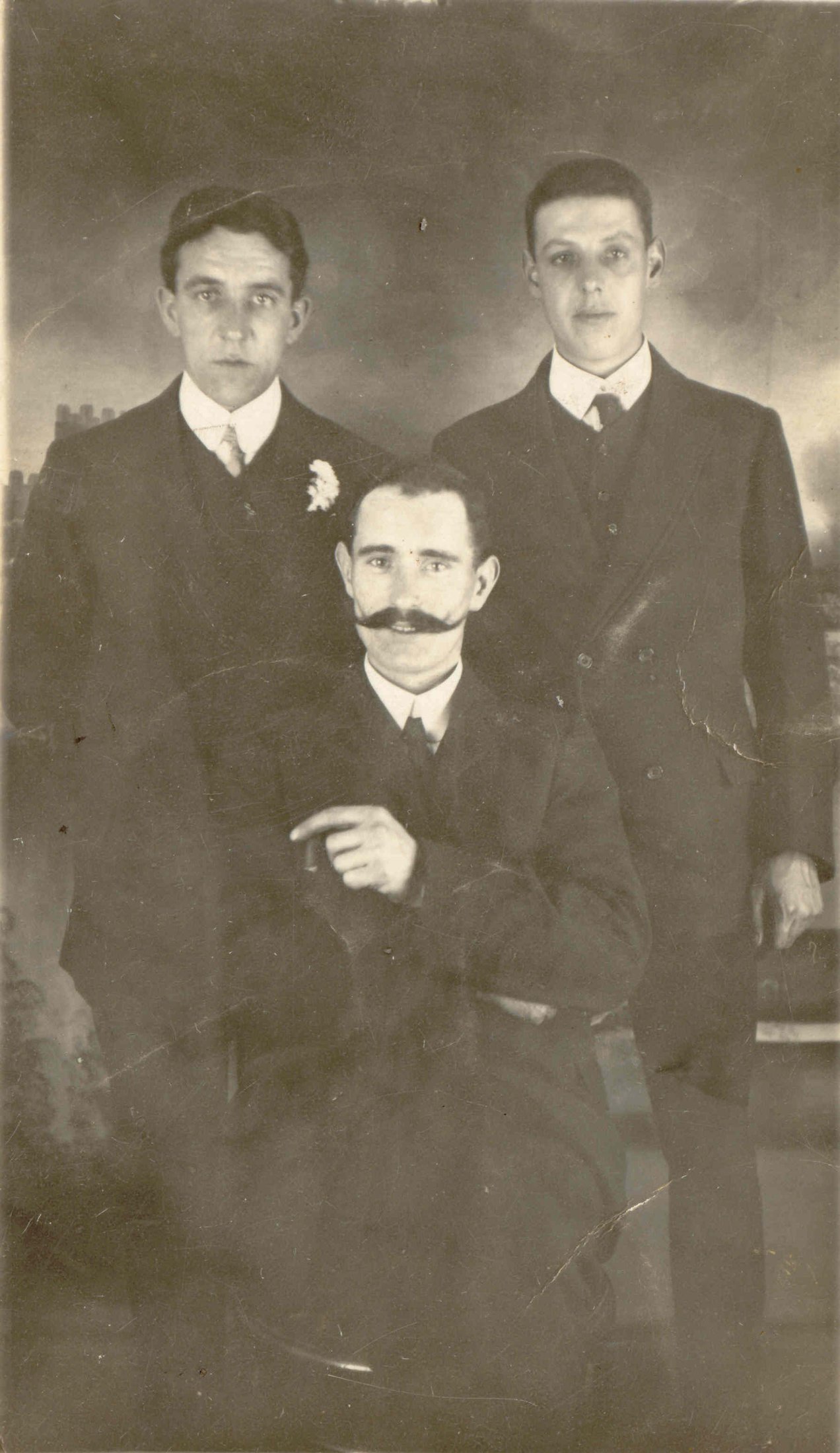
And Alexander was not alone for long. In May 1911 his brother, Hugh Wylie Shearer, followed him out from Scotland, sailing into Sydney on the Runic - the two of them plainly still in touch across the world, with Hugh coming to exactly where Alex had landed.45 From then on the brothers were a pair in the district; so when Alex sent home for Annie three years later, Hugh was no stranger down for a wedding but a Castlereagh man himself, and the natural one to stand beside his brother.
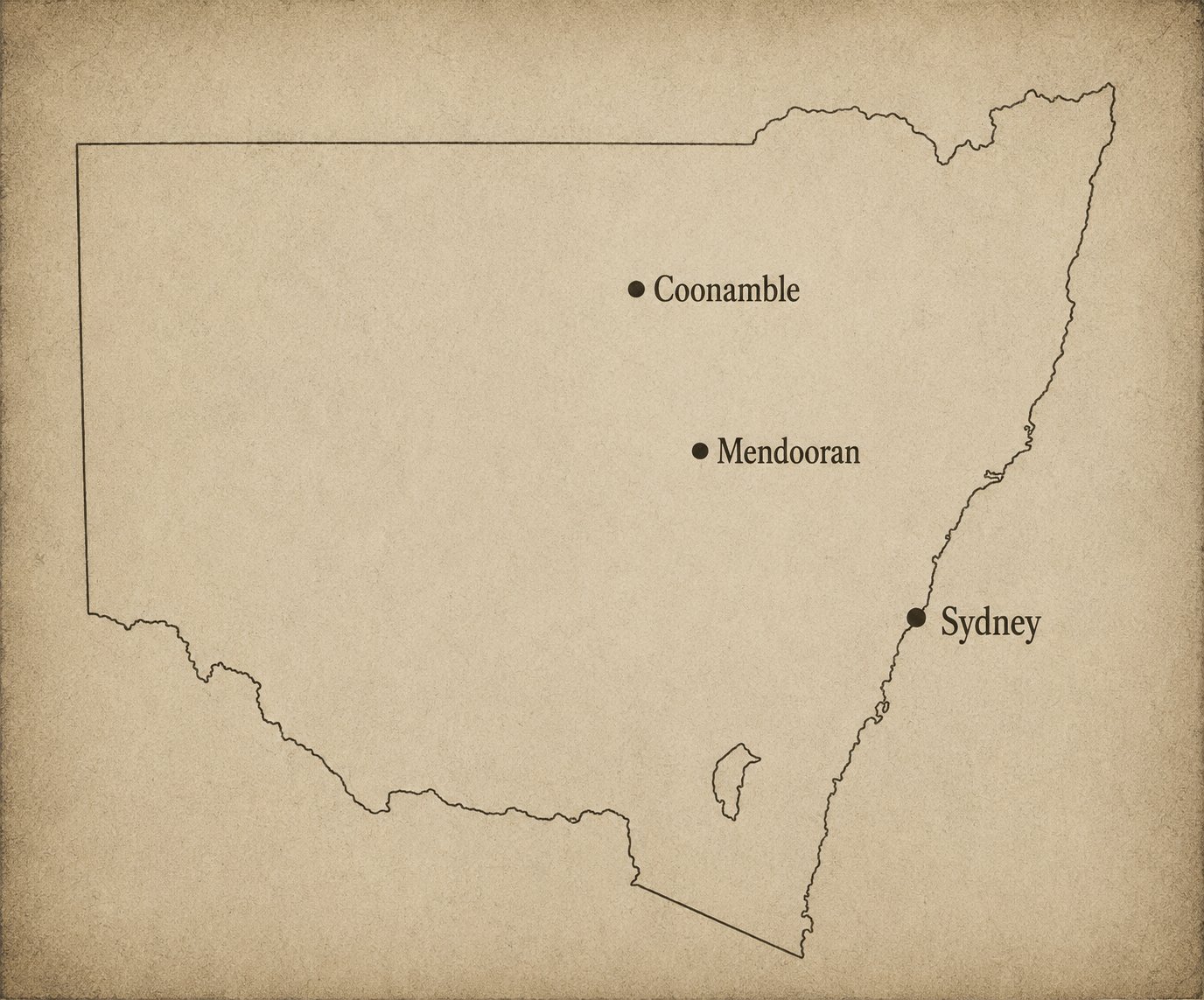
And he was still singing. The boy from the Ardrossan operetta became, in the bush, something of a local celebrity. In October 1912 he carried off the first-class gold medal for bass solo at the Coonamble Eisteddfod - a big open competition of some fifty classes that drew thousands over its two or three days - the test song being "Drinking." The Coonamble Times praised "the possessor of a cultivated light basso voice," and the news travelled all the way home: the Ardrossan & Saltcoats Herald ran the story in January 1913 under the headline "Vocalist's Success in New South Wales."14 Wherever Alexander Shearer was, there was singing - and now there were prizes for it.
That a wheat-and-shearing town on the Castlereagh should hold an eisteddfod of some fifty classes, drawing thousands over two or three days, can surprise a modern reader - but it was entirely of its time. Country New South Wales in the 1910s took self-improvement seriously: the eisteddfod, the School of Arts, the church choir and the friendly-society hall were how a raw district built a cultural life of its own, and a first-class gold medal for bass solo was a real local honour. Alexander had walked out of one singing town, Ardrossan, and found another waiting for him half a world away.88
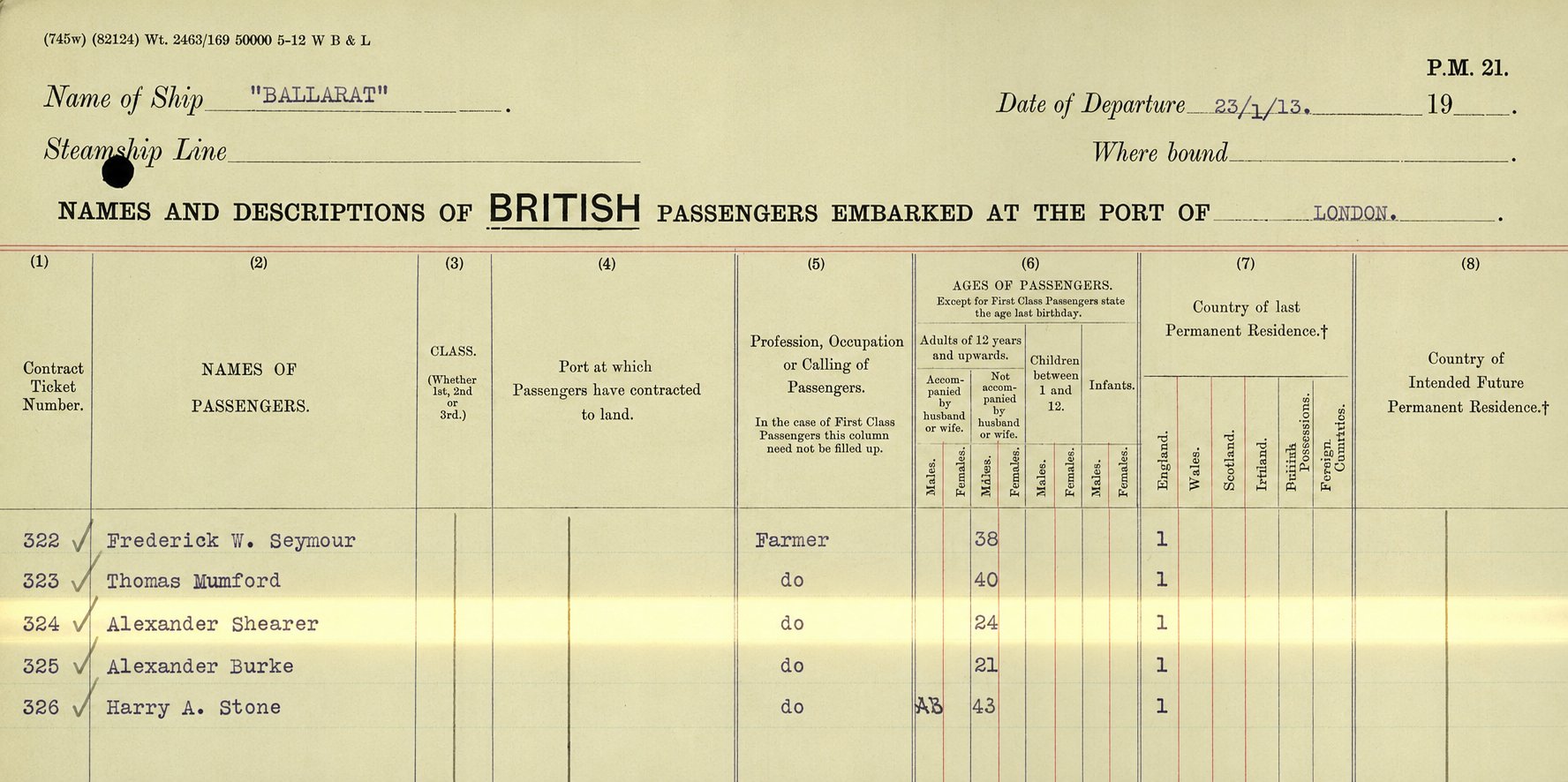
Late in 1913 he did a remarkable thing for a working man: he sailed back to Scotland. The departure record from London lists him plainly - "Farmer, age 24."15 By family account, he went home to ask Annie Barclay Tyre to marry him. Whatever had passed between the two of them in Ardrossan, it had held across three years and half a world. She said yes.
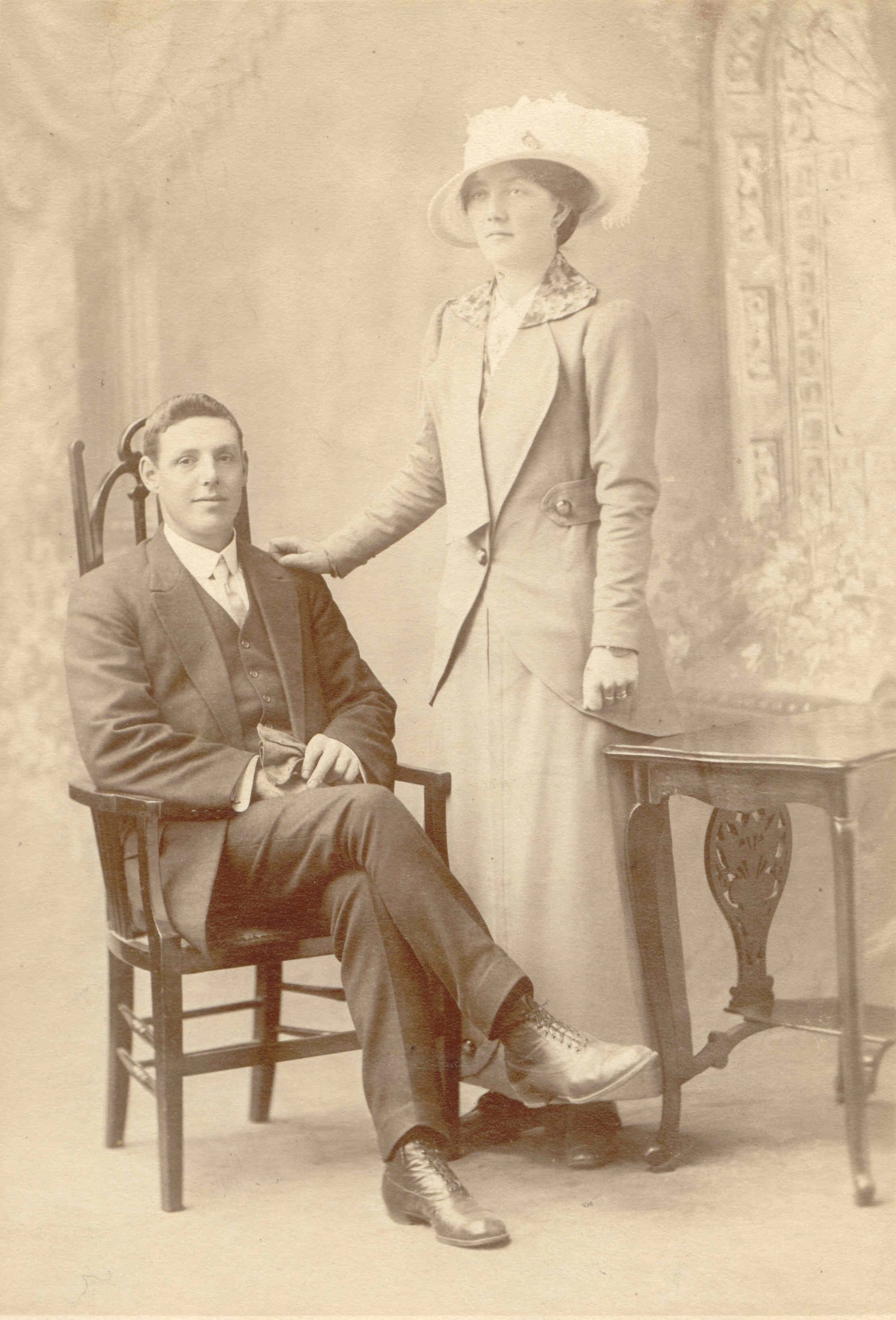
Annie sailed for Australia and reached Sydney on 26 July 1914, bound for Alexander at Coonamble.16 Two days later, on 28 July 1914, they were married at the Neutral Bay Presbyterian Church in North Sydney, the Reverend Robert H. Waugh officiating, with Alexander's brother Hugh among the witnesses.17 She had stepped off the ship and into a marriage inside forty-eight hours. Five days after that, on the other side of the world, the Great War began.
Chapter Four · 1914-1921
Ardrossan in Australia
❧
It is December 1917, just outside the village of Mendooran. The sign is his own work - planed smooth, the letters laid out careful and proud: Ardrossan. Alex gets his tools out of the bag, the same tools that crossed the world with him, the metal catching the hard inland sun.
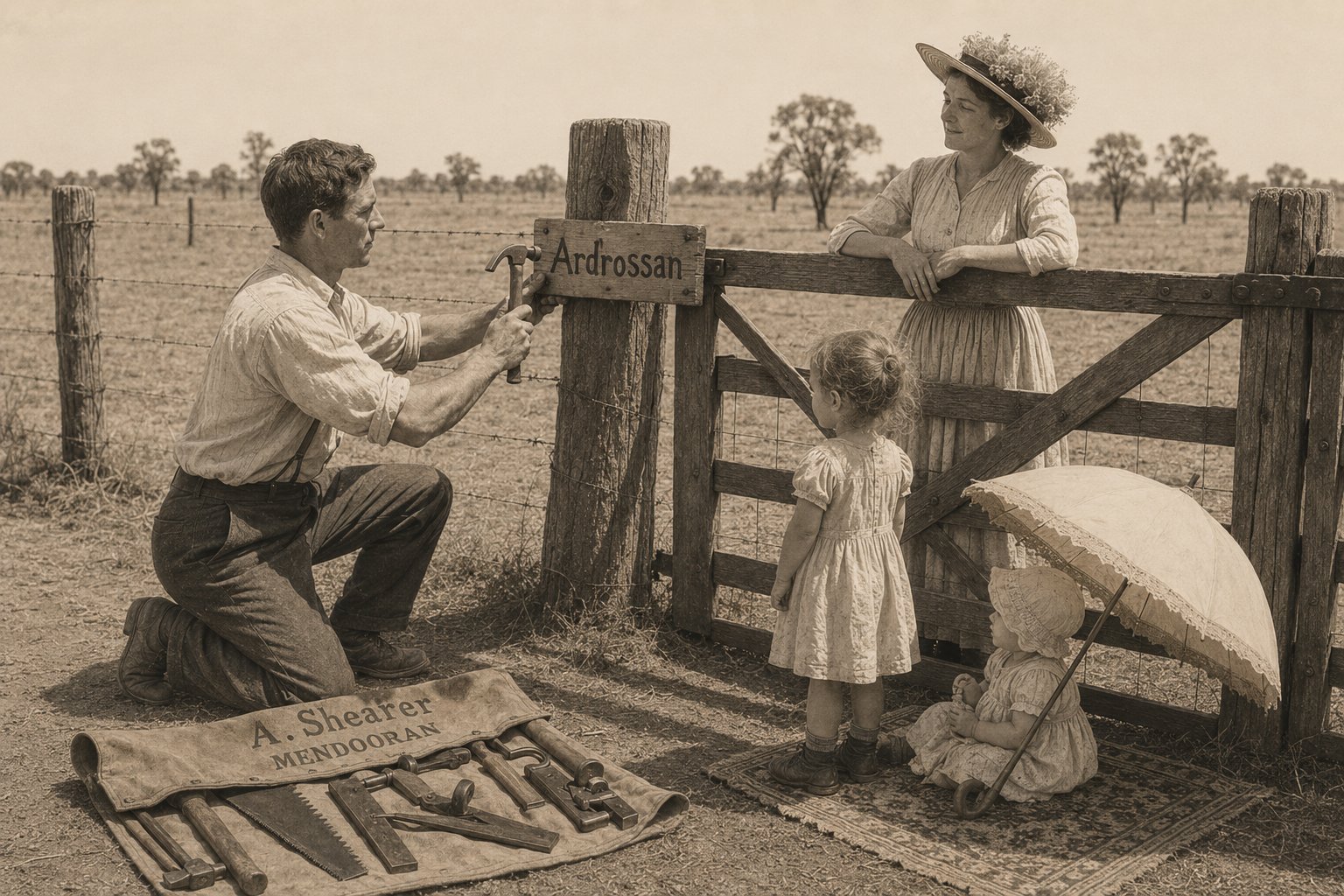
He checks it true, and drives home the nail - three good blows, and the name of a cold grey Scottish town stands in a hot dry New South Wales paddock.
Annie is leaning on the gate, watching him, and the two little girls are watching too, solemn as judges. The paddock runs away behind them, down and down, to the thin line of the Merrygoen Creek - dry as ever this time of year, a string of stones and shade.
"There," he says, stepping back. "Ardrossan." And he looks at it, and looks at her, and something in the day is too good to keep still.
So Alex takes a run and jumps the gate - clears it clean, to a shriek of delight from the girls - and catches Annie round the waist and turns her once, twice around in the dust, singing her a line of something.
About as far from the Firth of Clyde, he thinks, with his wife laughing in his arms, as a man could possibly get. And he would not trade it for the world.
❧
They did not stay at Coonamble. Their eldest, Margaret - Meg - was born there in 1915, at a place called "Roslin" in Warrana Street.18 But by 1917 the little family had moved south to a leased property on the Castlereagh Highway near Mendooran, and Alexander named it "Ardrossan", after the harbour town he had left.19 The name still stands on the land today. And still there more than 100 years later. There is no neater emblem of the whole migration than a Scottish seaman planting his birthplace, in his own painted letters, in a dry New South Wales paddock - carrying home across the world and nailing it to a post.
Mendooran in these years was a small but rising railway town on the Castlereagh, and it needed precisely what Alexander could do. A town becomes a town when someone builds its stores, halls, houses and public rooms, and a builder-contractor stands at the centre of that work. Shearer & Allan were tendering for the work that builds a town because there was, just then, a town being built.66
At Mendooran Alexander became more than a jobbing carpenter. By 1918 he was a builder and contractor in the partnership of Shearer & Allan, tendering for the kind of work that builds a town.20 We know this because of a letter - one of the small miracles of this family's record. On 7 April 1918, from "Ardrossan", Mendooran, Alexander wrote to his brother Bill back in Scotland, and in it you can hear the man whole.
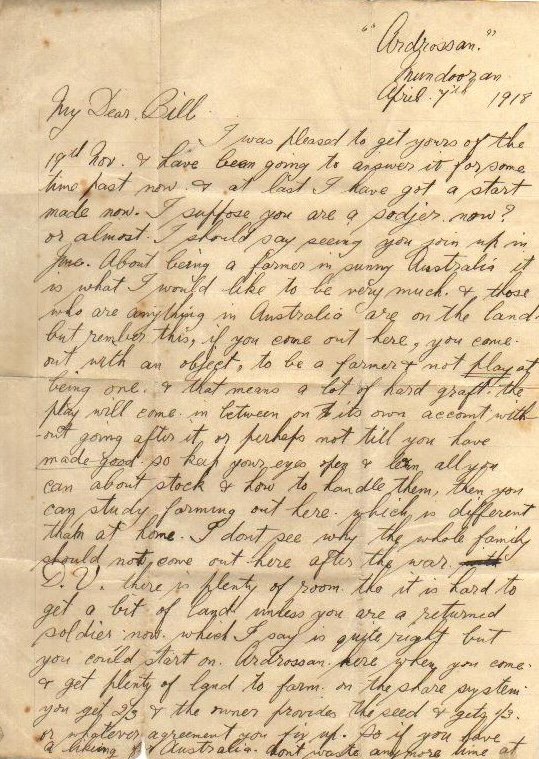
"About being a farmer in sunny Australia it is what I would like to be very much, and those who are anything in Australia are on the land. But remember this - if you come out here, you come out with an object, to be a farmer and not play at being one. And that means a lot of hard graft…"
"I don't know another country with a future of it like Australia; it has every resource wanted for self keep and must go ahead… Wee Meg and the wife are in tiptop health at present, and Hugh is expecting to start work again next week… Shearer and Allan were lowest tender for a £2100 job in Coonamble, but it is put off… and we lost an £850 job a week ago by £9 - hard luck, eh?"
"…with love to Mother and Meg ××× and kindest regards to you boys I must close now. Your loving brother Alex ××× from Meg, bless her wee heart."21
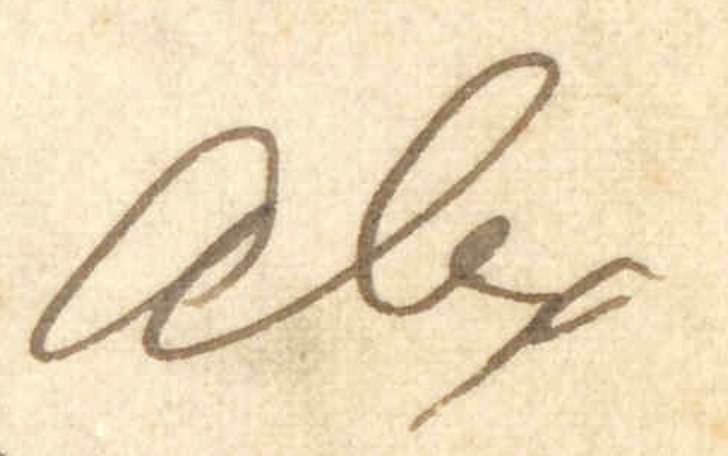
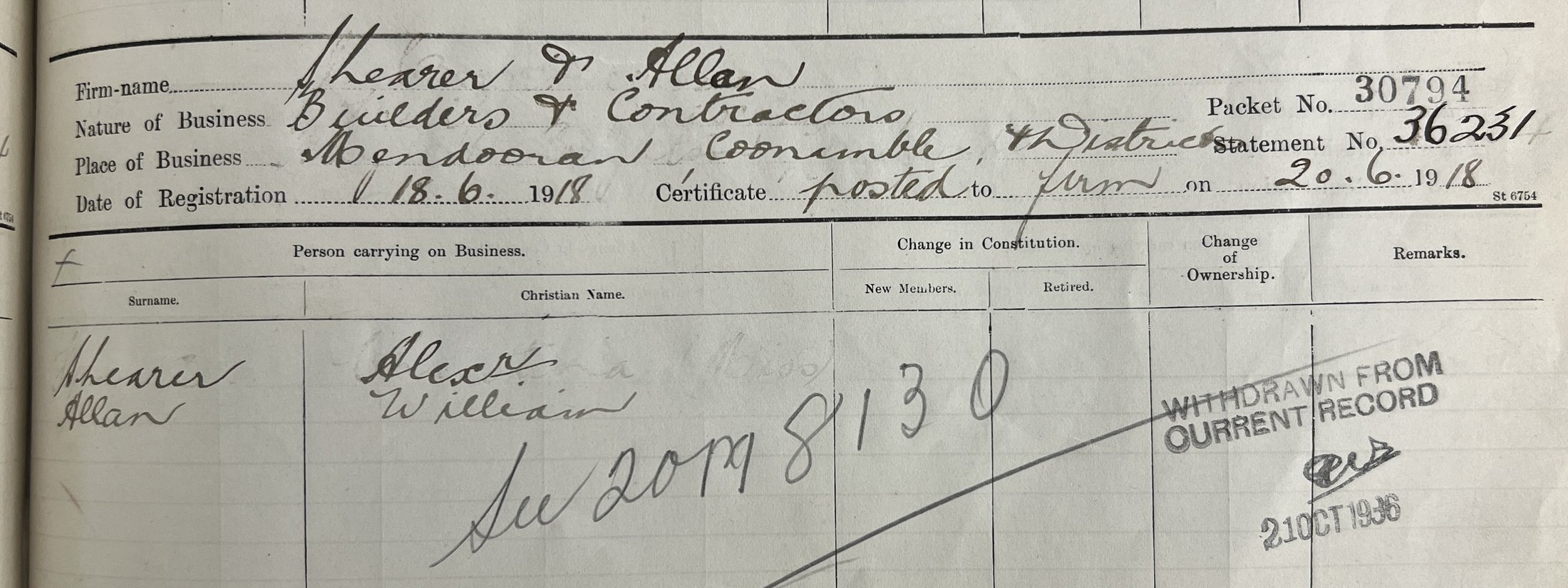
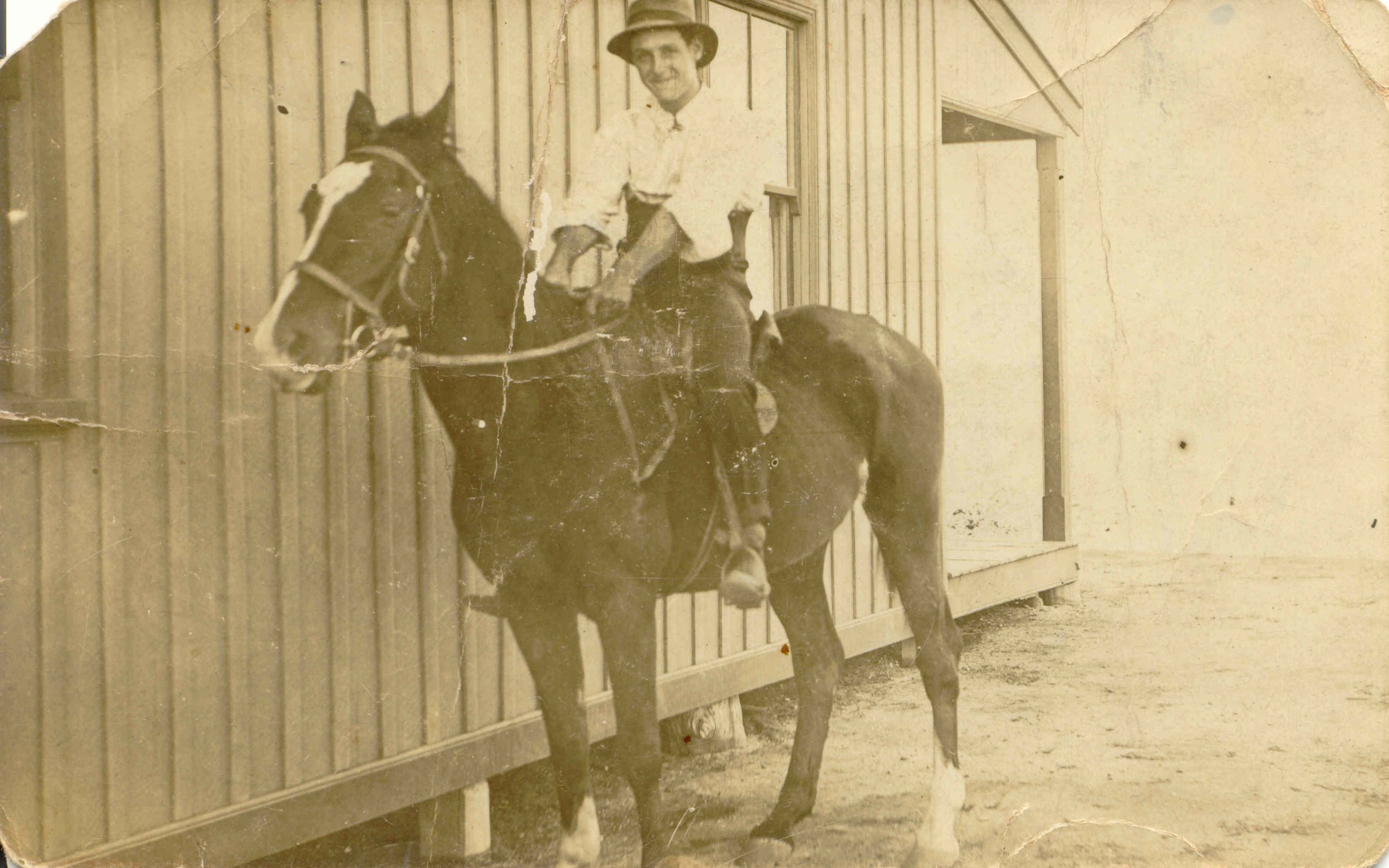
It is all there: the ambition and the realism in one breath, the pride in "Ardrossan", the tradesman's eye for a tender lost by nine pounds, and underneath it all the warmth - the kisses sent from a three-year-old, the brother urged to come out and make good. This was a man building something, and meaning it to last.
And the two brothers kept the old Ardrossan habit of singing alive in the bush. At a crowded send-off in the Mendooran town hall in January 1917 - a farewell to a local lieutenant bound for the front - both Shearers took the floor: Hugh sang "Heroes of the Dardanelles" and "A Deathless Army" to warm applause, and Alex gave "Mary" in his usual musical voice, and was called back for an encore.46 At the piano that night, as it happened, was a young A. E. Cruickshank - a name that would appear again twelve years later as a witness at Annie's second wedding.
The family grew. After Meg (1915) came Catherine in 1918.22 Alexander kept up his lodge ties in his new country - they would matter enormously later - and he kept his horse and his place in the district's life. He did not enlist in the Great War; family tradition holds that his brothers in Scotland wrote urging him to stay where he was23 - to keep building the life he had made, and leave the fighting to others. He took the advice. It is one of the quiet ironies at the centre of this story, and we will come back to it: the man who was told to stay safe, and stayed, would not see thirty-four.
His choice not to go carried more weight than a modern reader might guess. In a small country town between 1916 and 1918 the pressure to enlist was intense and public - honour rolls in the halls, recruiting marches down the main street, and hard words for the men who stayed - and the nation tore itself in half over two conscription referenda on exactly this question. For a Scottish-born tradesman with a young family and a business to keep, staying was defensible and still conspicuous; that his own brothers wrote from Scotland urging him to stay only sharpens the irony the story keeps returning to.92
In the last days of November 1921, Alexander caught pneumonia. There were no antibiotics; with his heart failing under it, the illness ran its course in a few days. He died at "Ardrossan", Mendooran, on 1 December 1921, aged thirty-three.24 The local paper was brief and sincere.
Some hundred Oddfellows and Masonic brethren followed him to the Mendooran cemetery, where his headstone carries the square and compass of his lodge.26 Sixteen days after he died, on 17 December 1921, his third daughter was born and named Alexandra - Lex - for the father she would never meet.27
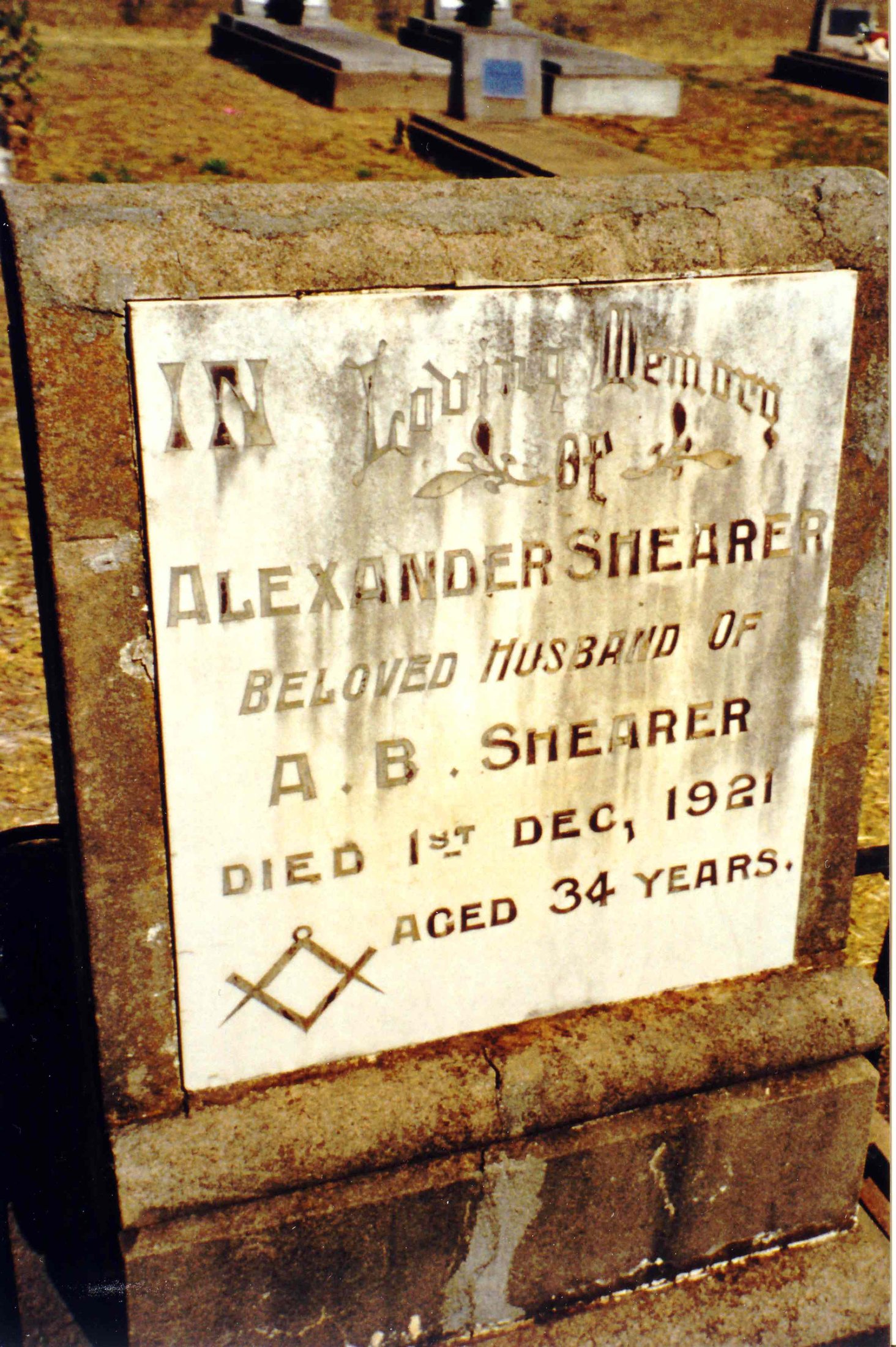
Pneumonia in 1921
Before antibiotics, pneumonia killed the strong as readily as the weak. In a fit man of thirty-three it could go from a chill to a crisis in under a week, the lungs filling faster than the body could clear them, the heart finally giving way. A country doctor could do little but wait. It is worth saying plainly what the record does not say: although the 1918-19 influenza pandemic - which killed so many through exactly this kind of pneumonia - was fresh in every memory, that great wave had passed through Australia by late 1919, and nothing in Alexander's papers ties his death two years later to it. His was, so far as we can tell, an ordinary, terrible pneumonia. The cruelty is in that ordinariness: a now-survivable illness took a young builder at the height of his powers, in a few December days.
Alexander died intestate, and the probate file is its own kind of portrait. The Public Trustee's inventory lists a life-assurance policy with the National Mutual - policy number 213889 - paying out £277/1/3; against it, an overdraft of £134/12/1 at the Mendooran bank.28 And it lists, item by item, the tools of his trade, valued at £19/18/0: a mitre plane at £3, a Stanley plane No. 45, a levelling instrument, thirteen chisels and gouges, a sixty-six-foot tape, down to a glue pot at fivepence. When the debts were paid, the estate came to £162/7/2 - a modest sum, and a young family's whole security. It was the insurance policy, more than anything, that would let Annie do what she did next.
Chapter Five · 1921-1929
After Alex
❧
It is November 1922, above the shop, Ardrossan. She arrived in November, and Scotland met her the way Scotland does - cold, and dark by half past three, the rain coming sideways off the Firth.
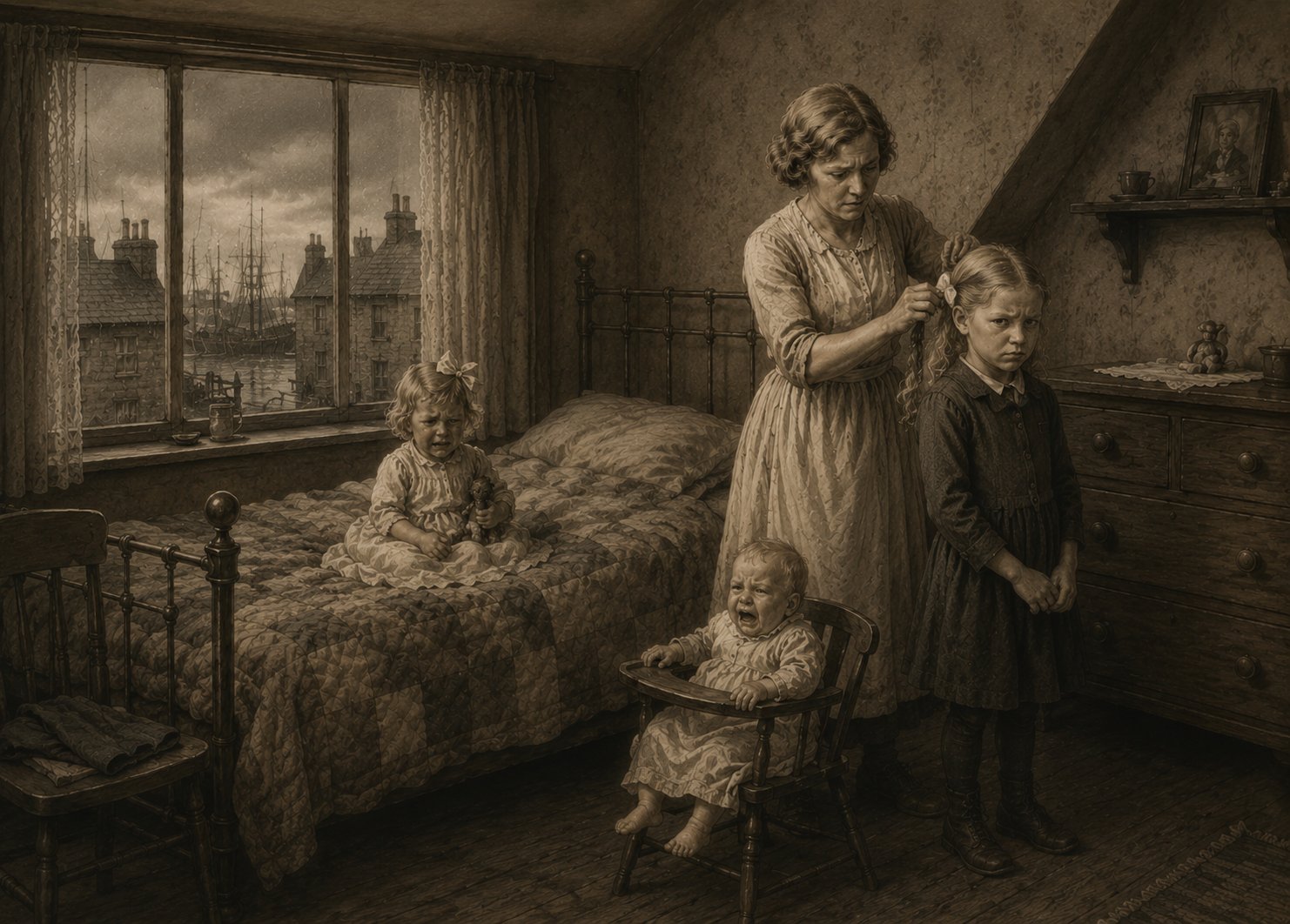
The room is upstairs, above her parents' shop, and they have been so good to her. They have given her work, a way to earn her keep and keep her hands busy; they fuss over the girls; they are kind and loving of course, and she is thankful for it. She tells herself so, every day.
But she sits in the lamplight with the three of them close around her - Meg, Catherine, and the baby Lex - and the children are finally sleeping.
She had thought coming back would be coming home. She had crossed the world in 1914 with a husband to go to; she has crossed it again with three fatherless girls and now the truth has finally caught up with her.
No matter how much love there is, this is not home anymore. The warmth is. The dry paddock is. The community on the far side of the earth - that is home now.
She pulls the blanket up over Lex. Right, she thinks. When I can manage it. We go back.
❧
Annie Shearer was thirty-two, with three daughters under seven and the youngest a newborn. What she did over the next eight years is the heart of why this family survived. The lodge death-funds and Alexander's insurance gave her a little ground to stand on; everything after that she did herself.
It is worth pausing on what a widow of thirty-two actually faced in 1922. There was no meaningful widow's pension, few respectable trades open to a woman, and a mother of small children was expected to manage on whatever a husband had left and whatever her own hands could earn. Annie had two assets - a trade in her fingers from her draper's upbringing, and the small capital of Alexander's insurance and the lodge death-funds - and she used both. What looks from here like a modest shop and a little dressmaking was, in the terms of its day, a woman engineering her family's survival with almost nothing beneath her.93
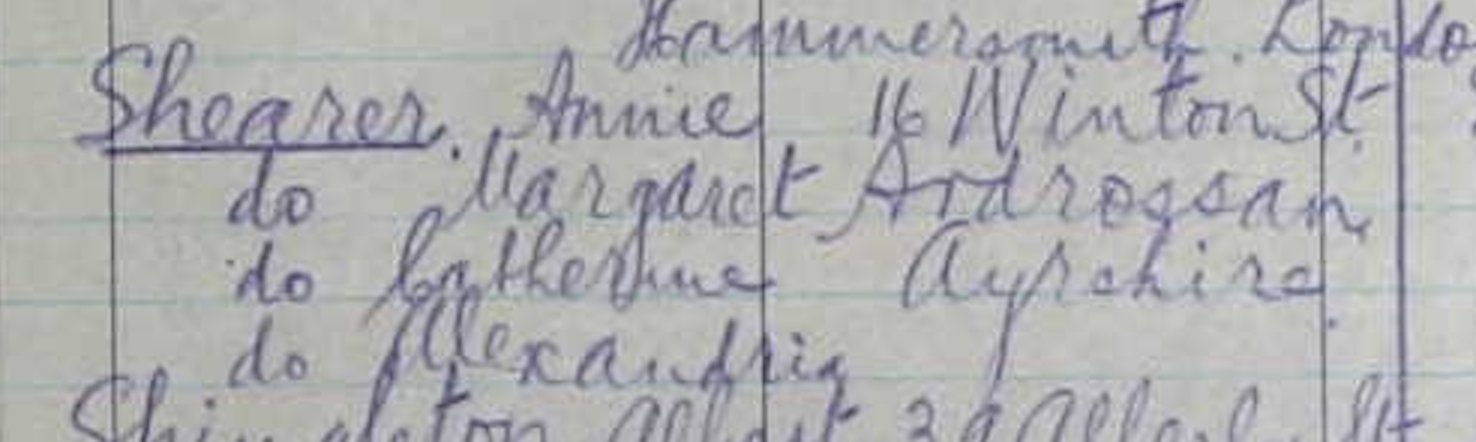
Her first instinct was the natural one: go home. In 1922 she took all three girls back to Scotland, arriving on 1 November 1922, to her own people at Ardrossan.29 It did not answer. The cold, the dark, the grief, the sense of no longer fitting the town she had left - and so, after a little under two years, she made up her mind. About July 1924 she brought the children back to Australia.30 She had now crossed the world three times. She did not cross it again.
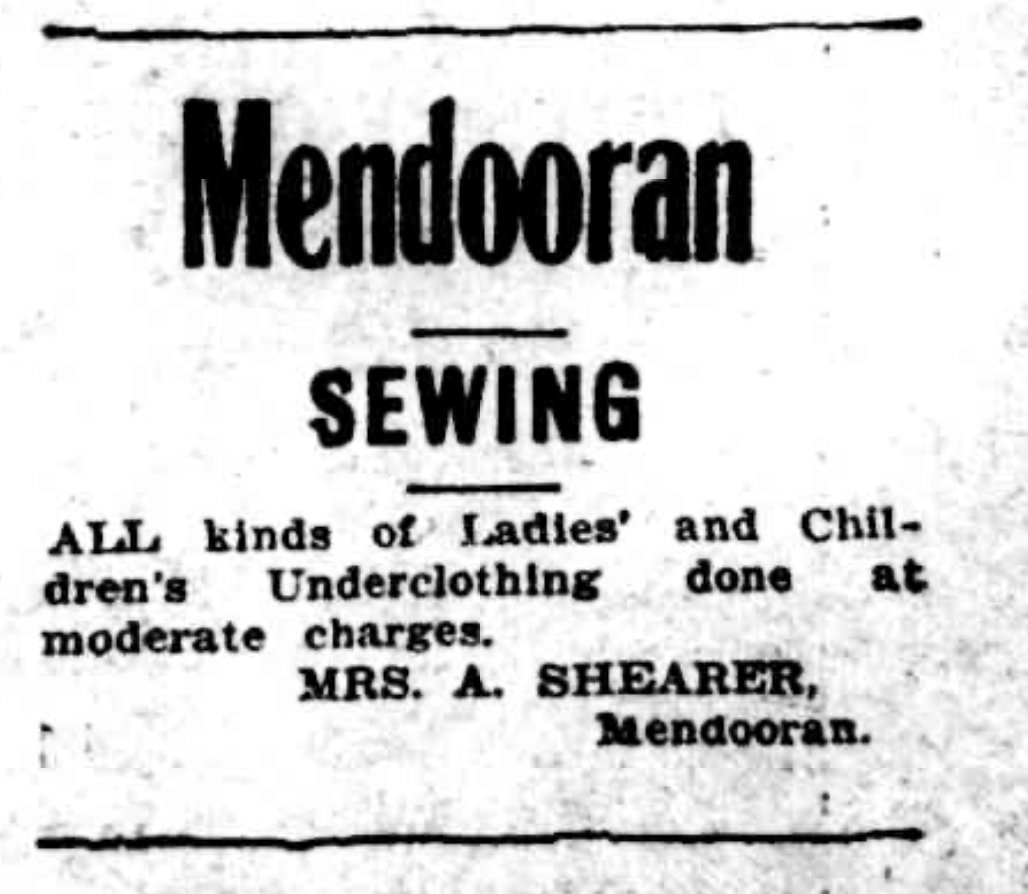
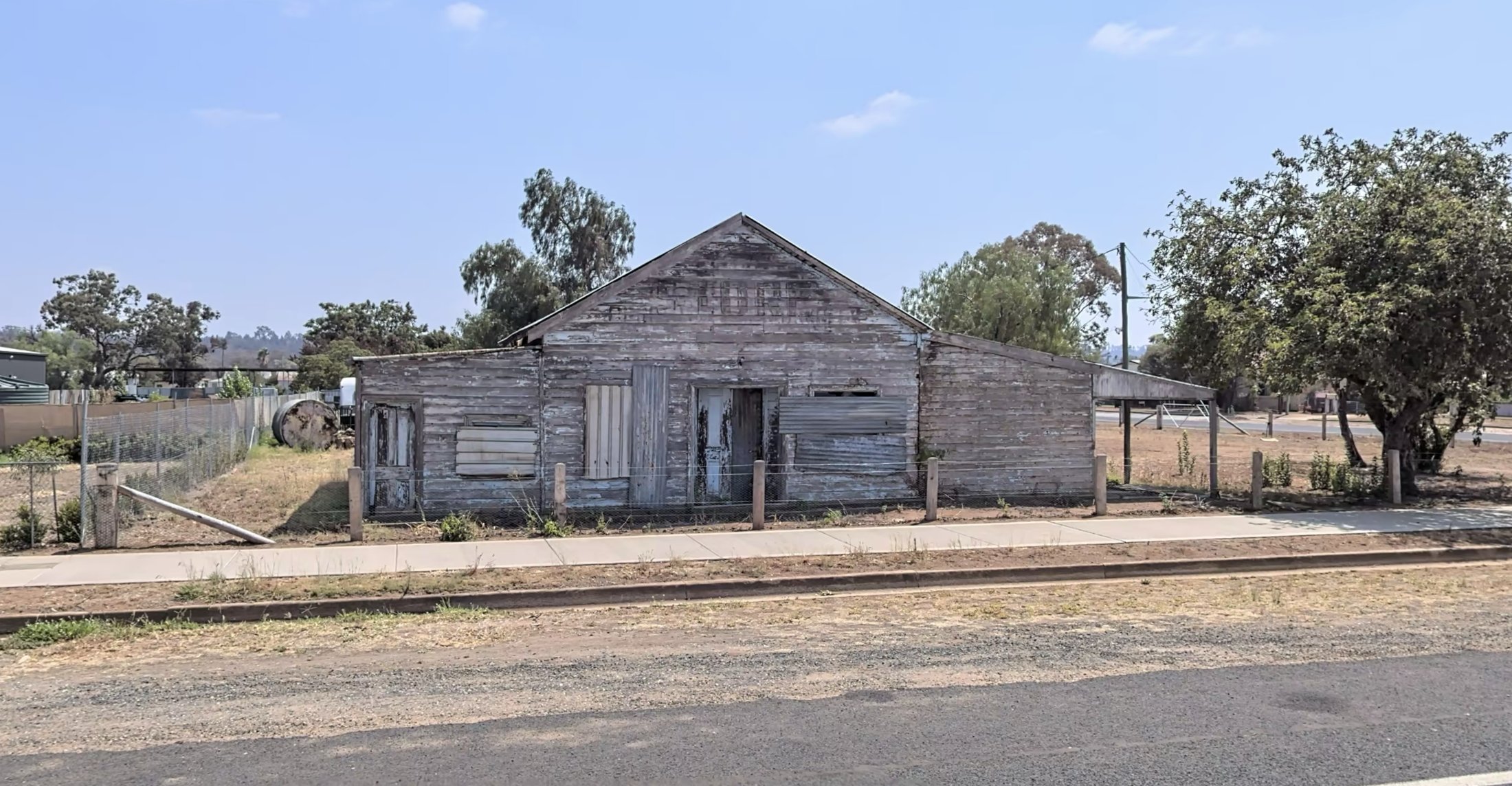
Back at Mendooran she set about making a living in the most practical way she could, and she did it on two fronts at once. The draper's daughter put her needle to work: in October 1924 she was advertising in the Mudgee Guardian - "Sewing. All kinds of ladies' and children's underclothing done at moderate charges. Mrs A. Shearer, Mendooran."31 And then, in 1925, she went into trade on her own account. Among the new buildings going up in the town, the paper noted a shop "which Mrs. A. Shearer intends opening as a fruit shop."32 Needle and shopfront together: a fruit and refreshment shop on the main street of a railway town, and dressmaking by lamplight after hours. It was modest. It was hers.
A lodge that reached forward
Alexander's Masonic membership, taken up in Ardrossan in 1909, did something he could never have foreseen. As the daughters of a deceased Freemason, his girls became eligible to board at the William Thompson Masonic School at Baulkham Hills, founded in 1922 for exactly such children.33 It was a real help to a widowed mother - and a real hardship too: the girls were sent away to school, came home for the holidays, and did not much like the parting, though there were not many other options open to a woman in Annie's position. A young tradesman's evening at the lodge, thirty years on, was helping to raise and school his children.
By the later 1920s Annie was a woman of standing in Mendooran in her own right - a shopkeeper, a mother managing, a known quantity. And in the district was a returned soldier and farmer she had come to know: George Colley. In the years after Alexander's death the two of them grew closer - slowly, in the way of two careful grown people who had each seen hard things - and at last, in 1929, they married.34 Tellingly, when it came, the Mendooran town block was put into Annie's own name first - on 20 February 1929 - before the wedding.35 Whatever else she was becoming, she would not be becoming nobody.
Chapter Six · 1929-1979
George & Annie's Long Life
To understand the second half of Annie's life, we have to go back and bring a third person forward. George Colley was born in 1884, at Bathurst, a son of James Colley, and belonged to the Coolah district north-east of Mendooran. By 1915 he held "Wheatlands", a homestead farm of some 1,358 acres north of the town.36 He was, in short, exactly the kind of man Alexander had urged his brother to become: someone on the land, not playing at it.
George served in the Great War, and was badly gassed on the Western Front - an injury that troubled his heart and his lungs for the rest of his life. He also knew Alexander: by family account he visited the Shearers in Scotland while on leave, recuperating. He was welcomed home to Coolah in 1919.37 And like Alexander, he left a letter that lets us hear him. In January 1921 - while Alexander Shearer was still alive, a few miles away - George wrote to a hospital friend, Clifford Mason, with whom he had convalesced in England. It is wry, restless, unmistakably a voice.
"I arrived home OK on the good ship City of Exeter, and she was some craft I can assure you. Had six meals a day for some time until things settled down… I have just finished stripping the wheat - was 1600 bags, the best crop that I have had. I go in for mixed farming, got 640 sheep, a few cows and 10 horses; the only thing I require is a cook and a nurse, one that would give a man plenty of hot milk."
"The gas makes a man shake in the summer time, affects the heart, makes one feel as if he wants to chuck the seven… I say, when are you going to take a run out here? Come and stop at my place for six months, it would do you good."
"From your old bed mate, George Colley."38
That this letter survives at all is a small wonder: Clifford Mason kept it, carried it to Canada, and his son brought it to light again in 2019, nearly a century on. In it George is doing well - sixteen hundred bags of wheat, the best crop he had had - and joking about the gas in the same line. The damage and the determination, side by side. His earlier life, before about 1915, is one of the honest gaps in this story: we meet him already a grown farmer, and exactly where he came from is work still to be done.
In 1929 George Colley and the widowed Annie Shearer married, in the Dubbo district. A son, James - always "Bert" - was born in 1930.38 Annie was forty; she had a new husband, a fourth child, a farm, and the three Shearer girls growing up - mostly away at school now, home for the holidays. For a few years the ledger of her life finally seemed to be running the right way.
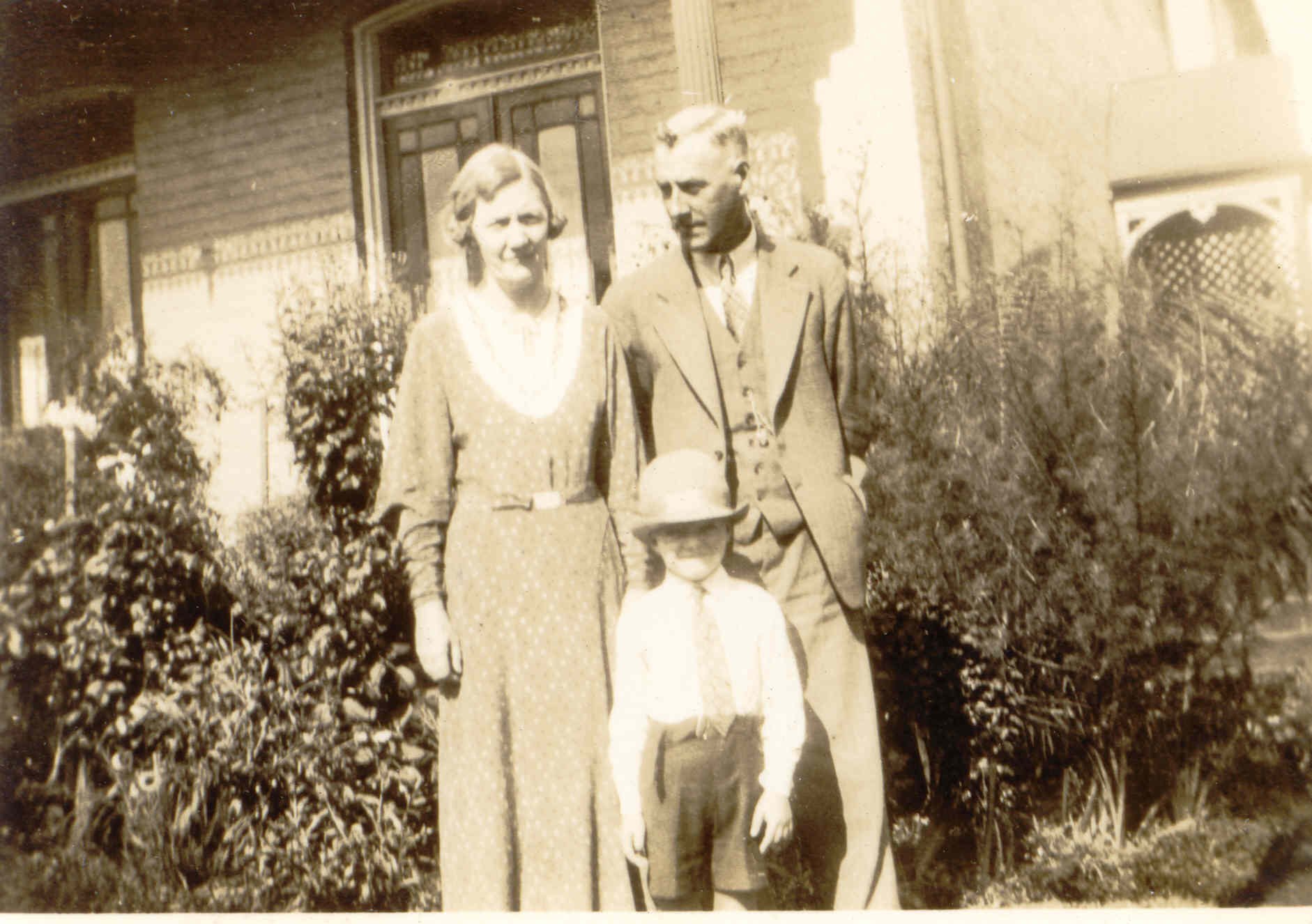
The good years did not last, and this time it was not bad luck but the whole world economy. As the Depression bit and wool and wheat prices halved, George's farms could not carry their debt. "Wheatlands" was surrendered to the bank sometime after 1931; a second block was gone by 1936; the land values were cut at the Valuation Court, and the mortgages did the rest.39 This was not a personal failing - it was the engine of the times, and it drove the family off the land and toward the city. By 1938 they were at Fairfield, in Sydney's west.40 The farm life was over.
The Colleys were not alone, and that matters. Across the wheat-and-wool country in the early 1930s thousands of closer-settlers and returned-soldier farmers - men put on the land in exactly George's years - were foundering on the same arithmetic: land taken up at good-times values, mortgaged, then caught when prices collapsed and the banks called the debt. The Valuation Court that cut George's land values was busy everywhere at once. What happened to "Wheatlands" was a private grief and a national event, both at once.70
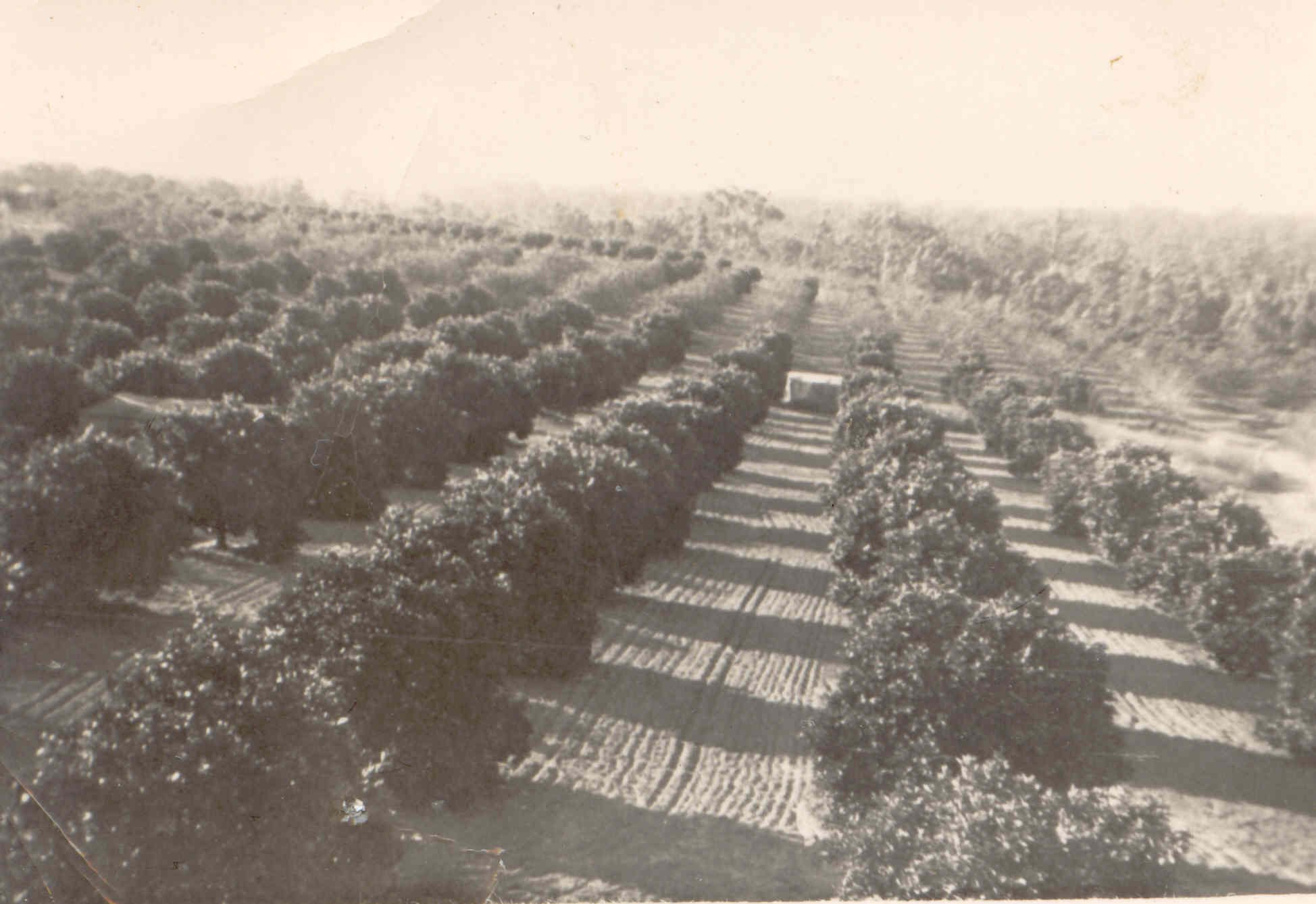
They did not stay beaten for long. On 30 August 1939 George bought a forty-acre orchard at Kenthurst, on Sydney's rural fringe, and called himself an orchardist.41 The family named the place Brucehaven. After the wheat-and-wool plains it was a different kind of farming altogether - closer, fiddlier, more hands-on - and the truth was they had it all to learn.
❧
It is April 1945, at "Brucehaven", the orchard, Kenthurst. They knew sheep. They knew wheat. Between them, George and Annie had spent years learning the dry inland - when to put a crop in, how a mob of ewes will move, the long gamble of rain.
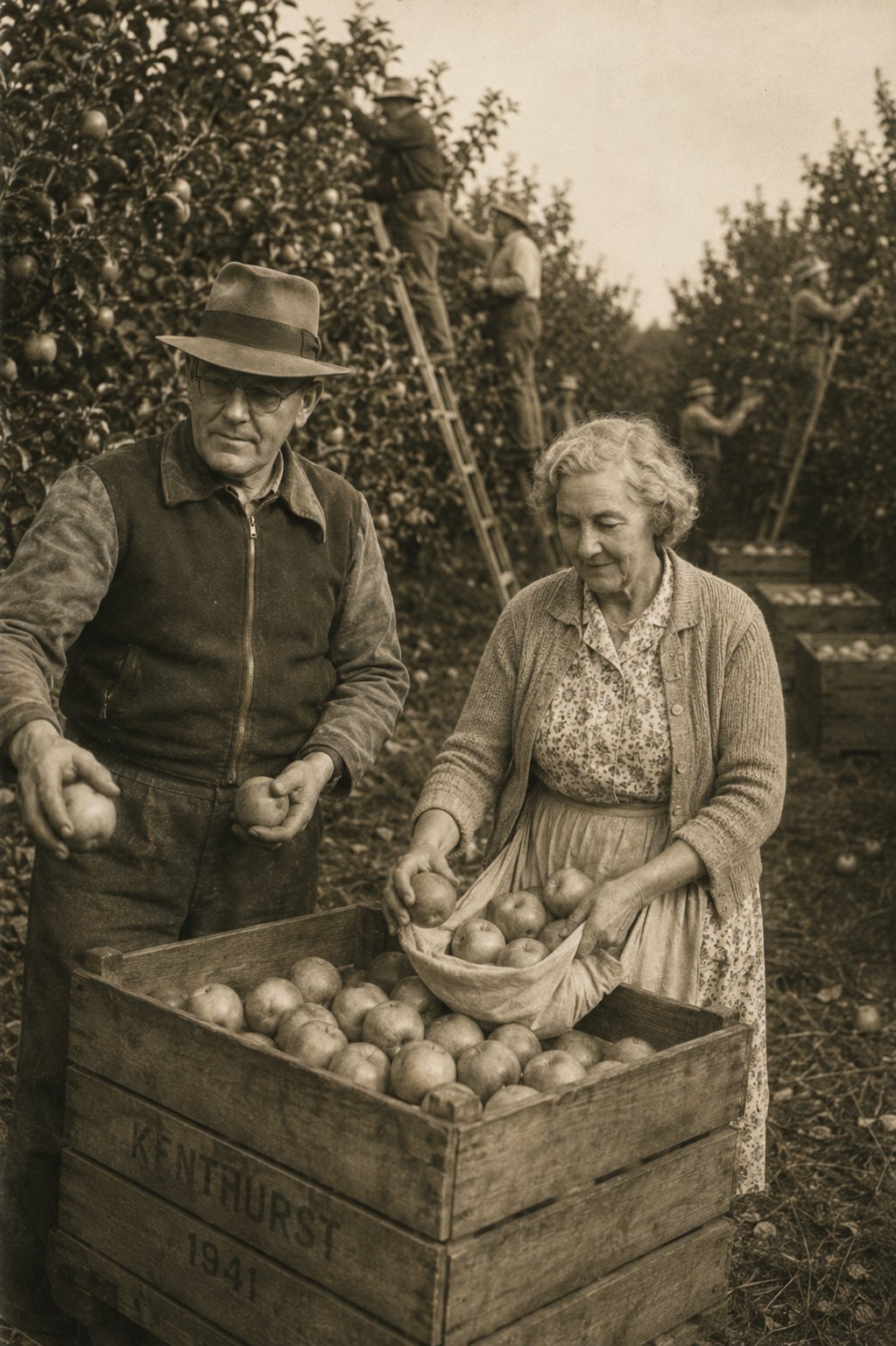
None of it is much use here.
An orchard is a fussy, close-up sort of farming, and they are learning it the hard way, one season at a time. When to spray, and what with. How to brush the fruit so it cases clean. Which way a laden ladder will tip if you lean out too far for the last good orange on the branch - George has found that one out already, and has the bruise to show for it.
But it is harvest, and the place is loud with family. The girls are grown and gone now, scattered to their own lives; they come back for holidays, and a harvest is as good a reason as any. So a son-in-law is carting cases two at a time, calling something cheeky up the row that makes Annie laugh and nearly drop an apronful of fruit.
Two people who lost a farm, and a fortune, and a first husband, and a war's worth of years to the gas - up ladders in the Kenthurst sun, learning a new trade in their fifties, with the children home and the cases filling.
It will do, Annie thinks. It will do very well.
❧
George Colley died at Kenthurst on 7 June 1950, his war-worn heart finally giving out.42 He had outlived the gas by thirty-two years. Here is the quiet irony the whole story has been circling: Alexander Shearer, who was advised to stay safe at home and did, died at thirty-three of an ordinary illness; George Colley, who went to the Western Front and was gassed, lived to be sixty-six. The man who stayed home died first; the man who went to war survived it.
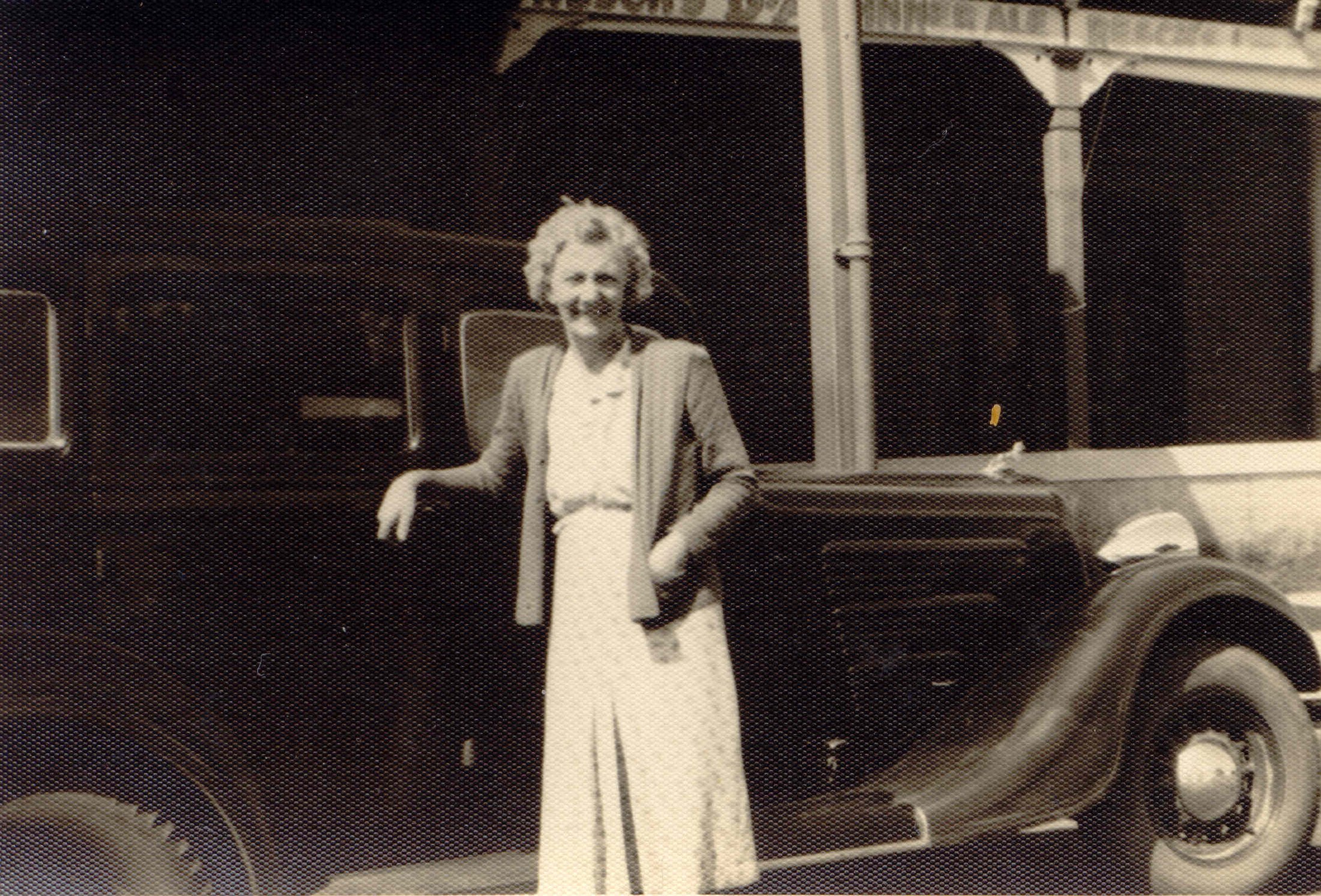
Annie sold the orchard the following year. She had been widowed twice now, and she did what she had always done - she carried on. She lived at Castle Hill through the 1950s, '60s and into the '70s, at 7 Church Street, and finally at Hornsby, an age pensioner.43 These last decades are thinly recorded - the documents grow sparse, and we will not invent what they do not tell us. Annie Barclay Tyre - Shearer, then Colley - died on 25 May 1979, at Hornsby, aged eighty-nine.44 She had outlived Alexander by fifty-eight years.
Two children of Ardrossan, a street apart, who grew up where the land ran out and the sea began. He carried the name of the town to the far side of the world and nailed it to a fence post; she carried the family through every loss the century could throw at it - a young husband, a war's worth of grief, a depression, a second widowhood - and kept walking. He is remembered in a few firm dates and one warm letter; she is remembered in fifty-eight years of getting on with it. From Ardrossan, all the way.
Appendix I · Biographies
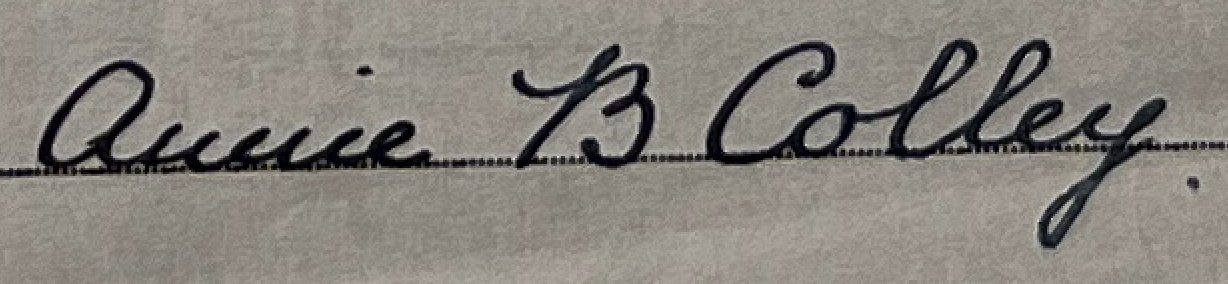
SHEARER, Alexander (1887-1921)
Alexander Shearer was born on 13 December 1887 at 9 Harbour Place, Ardrossan, Ayrshire, Scotland, the son of Alexander Shearer, ships' carpenter journeyman, and his wife Margaret, née Wylie. He was one of a large family of at least eight children raised in the Clyde-coast burgh - a port and shipbuilding town whose coal and pig-iron went out to Europe and North America, and where the sea was the natural road for a working man. The household moved about the town's tenement streets, and by the 1901 census thirteen-year-old Alexander was still a scholar at 214 Glasgow Street; that same year his father died of phthisis (tuberculosis), the disease of the crowded industrial west. His widowed mother afterward kept the Post Office on Glasgow Street.
He was a singer of some note - a member of the Ardrossan Musical Society, a pupil of J. W. Blythe, performing in a local operetta in 1908 - and in 1909 was raised a Master Mason in Lodge Saltcoats & Ardrossan No. 320, a brotherhood whose reach would, long after his death, shape his daughters' lives. Following his father into ship-work, Alexander went to sea with the Glasgow firms known as the "unlucky" Loch Line. He signed as an ordinary seaman on the barque Loch Katrine, and was aboard when she was dismasted in a gale off the New South Wales coast and towed crippled into Sydney in May 1910 - a dramatic entrance to the country that became his home.
Alexander settled at Coonamble on the Castlereagh, where the electoral roll of 1913 records him as a carpenter, and where he won the gold medal for bass solo at the 1912 eisteddfod. Late in 1913 he sailed back to Scotland - by family account, to propose to Annie Barclay Tyre. They married on 28 July 1914 at the Neutral Bay Presbyterian Church, North Sydney. The couple took up a leased property near Mendooran which Alexander named "Ardrossan", after his birthplace - the name still stands on the land today. By 1918 he had gone into business as a builder and contractor in the partnership of Shearer & Allan. He did not enlist in the Great War; family tradition holds that his brothers in Scotland wrote urging him to stay where he was. Three daughters were born - Margaret (1915), Catherine (1918) and Alexandra (1921).
Alexander did not live to see his youngest child grow: he died of pneumonia at Mendooran on 1 December 1921, aged thirty-three, sixteen days before Alexandra's birth. His funeral was led by some hundred Oddfellows and Masonic brethren, and he was buried at Mendooran beneath a headstone bearing the Masonic square and compass. He died intestate, leaving a life-assurance policy paying £277/1/3 and a carpenter's kit of tools; after debts, the net estate was £162/7/2.
SHEARER (later COLLEY), Annie Barclay (1889-1979)
Annie Barclay Tyre was born on 23 December 1889 at Alexander Place, Ardrossan, the daughter of James Tyre junior, draper, and his wife Margaret Campbell Stevens, née Thomson. By family account the Tyres were comfortable shopkeeping people who kept a nanny. Trained as a children's nurse, Annie emigrated to Australia, arriving at Sydney on 26 July 1914, bound for Alexander Shearer at Coonamble, and married him two days later.
Widowed in 1921 with three small daughters, Annie showed the resilience that runs through her whole life. She took the children home to Scotland in 1922, but returned to Australia about July 1924. Back at Mendooran she made her own way - advertising sewing and children's underclothing in 1924, then opening a fruit and refreshment shop in 1925. In 1929 she married George Colley at Dubbo; a son, James ("Bert"), followed in 1930. Tellingly, the Mendooran town block was transferred into Annie's own name before that marriage - a measure of her standing in her own right.
The Colleys farmed in the Mendooran district through the 1930s, but the Depression and the loss of the land brought them to Sydney by 1938, and on to an orchard at Kenthurst. Widowed a second time in 1950, Annie sold the orchard the following year and lived her later years at Castle Hill and finally Hornsby, an age pensioner, where she died on 25 May 1979. If George Colley and the Masonic community eased her road, the enterprise and endurance were her own.
COLLEY, George (1884-1950)
George Colley was born in 1884 at Bathurst, New South Wales, a son of James Colley. He belonged to the Coolah district, north-east of Mendooran, where his family was long established. As early as 1915 he held "Wheatlands", a homestead farm of some 1,358 acres north of Mendooran.
George served in the Great War and was badly gassed on the Western Front - an injury that troubled his heart and lungs for the rest of his life. He was welcomed home to Coolah in 1919, and a letter he wrote in 1921 to a hospital friend, Clifford Mason, speaks wryly of the gas that "makes a man shake". In 1929 he married the widowed Annie Barclay Shearer; their son James was born in 1930.
The good years did not last. As wool and wheat prices halved and the Depression bit, George's farms were mortgaged and lost - "Wheatlands" surrendered to the bank after 1931, the second block gone by 1936 - and the family looked to Sydney. In 1939 he bought an orchard at Kenthurst, describing himself as an orchardist, and there he died on 7 June 1950.
Appendix II · Family Group Sheets
Sheet 1 - SHEARER & TYRE
Husband
| Name | Alexander Shearer |
| Born | 13 Dec 1887, 9 Harbour Place, Ardrossan, Ayrshire Registry of Births, Deaths & Marriages, birth certificate, 1887 |
| Died | 1 Dec 1921, Mendooran NSW - pneumonia, aged 33 Registry of Births, Deaths & Marriages, death certificate, 1921 Death News Mudgee Guardian Thu, 1921 |
| Buried | Mendooran cemetery (headstone, Masonic emblem) Alexander Shearer's grave, Mendooran (headstone, 2 photos), 2004; held by the family |
| Parents | Alexander Shearer (ships' carpenter) & Margaret Wylie Alexander Shearer Father Family Group; held by the family Alexander Shearer Mother Family Group; held by the family |
| Occupation | Seaman (Loch Line) → carpenter → builder (Shearer & Allan, 1918) Alexander Shearer, arrival 1910 Business Record, 1918 |
| Property | "Ardrossan", leased, Mendooran (Portions 76/77) 'Ardrossan' leased property, Mendooran (Portions 76,77; 33ac, Castlereagh Hwy), 1917; NSW LRS Historical Land Records Viewer |
| Lodge | Lodge Saltcoats & Ardrossan No. 320 (Master Mason, 1909) Lodge Record Book, 1909 |
| Estate | Intestate; net £162/7/2 Probate/administration of Alexander Shearer, 1922 |
Wife
| Name | Annie Barclay Tyre → also Sheet 2 (m. Colley) |
| Born | 23 Dec 1889, Alexander Place, Ardrossan Registry of Births, Deaths & Marriages, birth certificate, 1889 |
| Died | 25 May 1979, Hornsby NSW Probate/administration of Annie Tyre, 1979 |
| Parents | James Tyre jr (draper) & Margaret Campbell Stevens Thomson Annie Tyre Father Family Group; held by the family Annie Tyre Mother Family Group; held by the family |
| Occupation | Children's nurse; later shopkeeper, Mendooran Annie Tyre, arrival 1914 New Shop Mudgee Guardian; Trove (National Library of Australia), Monday 27 April 1925, p.15; https://nla.gov.au/nla.news-article155934323 |
| 2nd marriage | George H. Colley, 1929 (→ Sheet 2) Ancestry - Australia Marriage Index 1788-1950, marriage certificate, 1929 (index entry; original certificate not yet obtained) |
Marriage
| Date | 28 July 1914 Registry of Births, Deaths & Marriages, marriage certificate, 1914 |
| Place | Neutral Bay Presbyterian Church, North Sydney Registry of Births, Deaths & Marriages, marriage certificate, 1914 |
| Reg. no. | 1914/10505 Registry of Births, Deaths & Marriages, marriage certificate, 1914 |
| Religion | Presbyterian Registry of Births, Deaths & Marriages, marriage certificate, 1914 |
| Minister | Rob. H. Waugh Registry of Births, Deaths & Marriages, marriage certificate, 1914 |
| Witnesses | Hugh W. Shearer; Janetta M. Kirkwood Registry of Births, Deaths & Marriages, marriage certificate, 1914 |
Children
| # | Name | Born | Notes | Source |
|---|---|---|---|---|
| 1 | Margaret (“Meg”) Shearer | 1915 | b. Coonamble | Registry of Births, Deaths & Marriages, birth certificate, 1921 |
| 2 | Catherine Shearer | 1918 | b. Mendooran | Registry of Births, Deaths & Marriages, birth certificate, 1921 |
| 3 | Alexandra (“Lex”) Shearer | 17 Dec 1921 | b. Mendooran - 16 days after her father’s death | Probate/administration of Annie Tyre, 1979 |
Sheet 2 - COLLEY & TYRE
Husband
| Name | George Colley |
| Born | 1884, Bathurst NSW (owner record - to document) |
| Died | 7 Jun 1950, Kenthurst NSW Probate/administration of George Colley, 1950 |
| Parents | James Colley (father) (owner; mother -) |
| War service | WWI, A.I.F. - gassed, Western Front; welcomed home Coolah 1919 Returns from War Mudgee Guardian; Trove (National Library of Australia), Thursday 3 April 1919, p.11; https://nla.gov.au/nla.news-article157145382 George Colley's letter (provenance: David Mason email, 2 Sep 2019), 1921; held by the family |
| Occupation | Soldier-settler / farmer; later orchardist, Kenthurst Wheatlands Homestead Farm Grant (Portion 82, 1358ac N of Mendooran), 1915; NSW LRS Historical Land Records Viewer Orchard Kenthurst summary, 1940 |
| Property | "Wheatlands" (Portion 82, 1915); soldier block (1919); town block (1924); Kenthurst orchard (1939) Wheatlands Homestead Farm Grant (Portion 82, 1358ac N of Mendooran), 1915; NSW LRS Historical Land Records Viewer Returned Soldiers' Special Holding (403ac, Yarragrin/Caigan), 1919; NSW LRS Historical Land Records Viewer 1924 George Colley-Annie Tyre LAND - Mendooran town block (Allotment 6 Sec 8, Bandulla St), 1924; NSW LRS Historical Land Records Viewer Orchard Kenthurst summary, 1940 |
Wife
| Name | Annie Barclay Tyre (widow of A. Shearer) → Sheet 1 |
| Born / Died | 23 Dec 1889, Ardrossan - 25 May 1979, Hornsby Registry of Births, Deaths & Marriages, birth certificate, 1889 Probate/administration of Annie Tyre, 1979 |
Marriage
| Date | 1929 Ancestry - Australia Marriage Index 1788-1950, marriage certificate, 1929 (index entry; original certificate not yet obtained) |
| Place | Dubbo district, NSW (registration) Ancestry - Australia Marriage Index 1788-1950, marriage certificate, 1929 (index entry; original certificate not yet obtained) |
| Reg. no. | 15776/1929 Ancestry - Australia Marriage Index 1788-1950, marriage certificate, 1929 (index entry; original certificate not yet obtained) |
| Note | Town block transferred to Annie 20 Feb 1929, before the marriage 1924 George Colley-Annie Tyre LAND - Mendooran town block (Allotment 6 Sec 8, Bandulla St), 1924; NSW LRS Historical Land Records Viewer |
Children
| # | Name | Born | Notes | Source |
|---|---|---|---|---|
| 1 | James Herbert (“Bert”) Colley | 1930 | son of George & Annie | Ancestry - Australia Marriage Index 1788-1950, marriage certificate, 1929 (index entry; original certificate not yet obtained) |
References
- Birth registration, Alexander Shearer, 13 Dec 1887, Ardrossan - Registry of Births, Deaths & Marriages, birth certificate, 1887; family record Alexander Shearer Father Family Group; held by the family.
- Ardrossan censuses 1891 & 1901 (Bute Place; 214 Glasgow Street) - 1891 Census, 1901 Census; town context Ardrossan, Ayrshire - port & shipbuilding town (Barr & Shearer yard from 1848), Wikipedia, 'Ardrossan'; retrieved 2026-06-18; https://en.wikipedia.org/wiki/Ardrossan.
- 1901 census & death of Alexander Shearer sen. (phthisis) - 1901 Census, Alexander Shearer Father Family Group; held by the family.
- "Vocalist's Success in New South Wales," Ardrossan & Saltcoats Herald, 10 Jan 1913, p.4 (naming "Mrs Shearer, Post Office, Glasgow Street, Ardrossan").
- Annie Tyre birth, 23 Dec 1889, Alexander Place, Ardrossan - Registry of Births, Deaths & Marriages, birth certificate, 1889.
- Tyre household (Glasgow Street; Seton Street); family tradition (comfortable, kept a nanny) - 1891 Census, 1901 Census, Lex Shearer Interview, 2004; held by the family.
- Annie trained as a children's nurse - Annie Tyre, arrival 1914.
- Ardrossan Musical Society; pupil of J. W. Blythe - Ardrossan & Saltcoats Herald, 10 Jan 1913.
- 1908 operetta - Operetta Performance News, 1908.
- Master Mason, Lodge Saltcoats & Ardrossan No. 320, 1909 - Lodge Record Book, 1909; headstone Alexander Shearer's grave, Mendooran (headstone, 2 photos), 2004; held by the family.
- The "unlucky" Loch Line; ordinary seaman, Loch Katrine - Loch Line of Glasgow / Loch Katrine - fleet & ship history, Wikipedia, 'Loch Line'; retrieved 2026-06-18; https://en.wikipedia.org/wiki/Loch_Line.
- Dismasting off Cape Perpendicular, 27 Apr 1910; towed to Sydney, anchored Athol Bight, 10 May 1910 - Alexander Shearer, arrival 1910, Loch Katrine Shipwreck, 1910.
- Coonamble electoral roll (carpenter, Namoi Street), 1913 - Electoral Roll, 1913.
- Gold medal, bass solo, Coonamble Eisteddfod, Oct 1912 (test song "Drinking") - Ardrossan & Saltcoats Herald, 10 Jan 1913 (quoting the Coonamble Times).
- Departure from London, 1913 ("Farmer, age 24") - Alexander Shearer, arrival 1913.
- Annie's arrival, Sydney, 26 Jul 1914 - Annie Tyre, arrival 1914, Annie Tyre, arrival 1914.
- Marriage, 28 Jul 1914, Neutral Bay Presbyterian Church (reg. 1914/10505) - Registry of Births, Deaths & Marriages, marriage certificate, 1914.
- Margaret ("Meg") Shearer b. 1915, "Roslin", Warrana Street, Coonamble - Registry of Births, Deaths & Marriages, birth certificate, 1915, Registry of Births, Deaths & Marriages, birth certificate, 1921.
- Move to "Ardrossan", Mendooran (Portions 76/77), by 1917 - 'Ardrossan' leased property, Mendooran (Portions 76,77; 33ac, Castlereagh Hwy), 1917; NSW LRS Historical Land Records Viewer, Letter to Brother, 1918; held by the family.
- Builder, partnership of Shearer & Allan, 1918 - Business Record, 1918.
- Alexander Shearer to his brother Bill, "Ardrossan", Mendooran, 7 Apr 1918 - family letter (S-LET 1918).
- Catherine Shearer b. 1918 - Registry of Births, Deaths & Marriages, birth certificate, 1921.
- Did not enlist; brothers urged him to stay (family tradition) - Lex Shearer Interview, 2004; held by the family.
- Death of Alexander Shearer, pneumonia, 1 Dec 1921, aged 33 - Registry of Births, Deaths & Marriages, death certificate, 1921; death certificate Death News Mudgee Guardian Thu, 1921.
- "Mr. A. Shearer" (death), Mudgee Guardian & North-Western Representative, 5 Dec 1921, p.10 - nla.news-article155644862.
- Funeral (Oddfellows & Masonic brethren); Mendooran headstone (square & compass) - Death News Mudgee Guardian Thu, 1921, Alexander Shearer's grave, Mendooran (headstone, 2 photos), 2004; held by the family.
- Alexandra ("Lex") Shearer b. 17 Dec 1921 - Probate/administration of Annie Tyre, 1979.
- Deceased-estate / probate file: National Mutual policy 213889 (£277/1/3); tools £19/18/0; bank overdraft £134/12/1; net estate £162/7/2 - Probate/administration of Alexander Shearer, 1922.
- Return to Scotland; arrived 1 Nov 1922; 16 Winton Place, Ardrossan - Annie Tyre, arrival 1922.
- Return to Australia, about July 1924 - Annie Tyre, arrival 1924.
- "Sewing… ladies' and children's underclothing… Mrs A. Shearer, Mendooran," Mudgee Guardian, 16 Oct 1924, p.7 - nla.news-article156053505.
- New fruit shop ("Mrs. A. Shearer intends opening as a fruit shop"), Mudgee Guardian, 22 Jan 1925, p.16 - nla.news-article155929831; also Opening of New Shop (Mudgee Guardian 27 Apr 1925), 1925.
- Daughters at the William Thompson Masonic School, Baulkham Hills (founded 1922) - William Thompson Masonic School, Baulkham Hills - founded 1922 for deceased Freemasons' children, Find & Connect (findandconnect.gov.au); retrieved 2026-06-18; https://www.findandconnect.gov.au/entity/william-thompson-masonic-school-3/.
- Marriage of George Colley & Annie Shearer, 1929, Dubbo district (reg. 15776/1929) - Ancestry - Australia Marriage Index 1788-1950, marriage certificate, 1929 (index entry; original certificate not yet obtained).
- Town block transferred to Annie, 20 Feb 1929 - 1924 George Colley-Annie Tyre LAND - Mendooran town block (Allotment 6 Sec 8, Bandulla St), 1924; NSW LRS Historical Land Records Viewer.
- George Colley b. 1884, Bathurst; "Wheatlands" (Portion 82, c.1,358 acres) by 1915 - Wheatlands Homestead Farm Grant (Portion 82, 1358ac N of Mendooran), 1915; NSW LRS Historical Land Records Viewer.
- War service; gassed; welcomed home Coolah, 1919 - Returns from War Mudgee Guardian; Trove (National Library of Australia), Thursday 3 April 1919, p.11; https://nla.gov.au/nla.news-article157145382, WW1 poison-gas long-term effects (chronic bronchitis; heart strain), Chemical Warfare & Medical Response During WWI, AJPH / NCBI PMC; retrieved 2026-06-18; https://pmc.ncbi.nlm.nih.gov/articles/PMC2376985/.
- George Colley to Clifford Mason, "Wheatlands", Mendooran, 27 Jan 1921; son James ("Bert") b. 1930 - George Colley's letter (provenance: David Mason email, 2 Sep 2019), 1921; held by the family; Ancestry - Australia Marriage Index 1788-1950, marriage certificate, 1929 (index entry; original certificate not yet obtained).
- Depression: "Wheatlands" surrendered after 1931; second block gone by 1936 - Wheatlands Homestead Farm Grant (Portion 82, 1358ac N of Mendooran), 1915; NSW LRS Historical Land Records Viewer, Great Depression in Australia - NSW unemployment ~10%→32%; wool & wheat prices halved; farm foreclosures; wheat relief to 1935-36; retrieved 2026-06-22; https://en.wikipedia.org/wiki/Great_Depression_in_Australia.
- At Fairfield, Sydney, by 1938 - Annie Moved to Sydney, 1938.
- Kenthurst orchard purchased 30 Aug 1939 (Portion 51, 40 acres) - Orchard Kenthurst summary, 1940.
- Death of George Colley, Kenthurst, 7 Jun 1950 - Probate/administration of George Colley, 1950.
- Castle Hill (7 Church Street), 1954-1977 - Electoral Roll, 1977.
- Death of Annie Colley, Hornsby, 25 May 1979, aged 89 - Probate/administration of Annie Tyre, 1979.
- Hugh Wylie Shearer, arrival in Sydney on the Runic, 26 May 1911 - Alexander Shearer, arrival 1911, NSW Unassisted Immigrant Passenger Lists, 1826-1922 (Ancestry); https://www.ancestry.com.au/search/collections/1210/records/1197445.
- "Mundooran Function" (H. Shearer and A. Shearer both singing) - Mudgee Guardian & North-Western Representative, 4 Jan 1917, p.16 - Alex and Hugh News, 1917.
Online Sources (captured in research)
Newspapers, archives & records
- Loch Katrine wreck reported - Daily Telegraph (Sydney), 9 May 1910, p.11 - nla.news-article239416462.
- Loch Katrine shipwreck - The Sydney Morning Herald, 11 May 1910, p.1 - nla.news-article15135149.
- "Vocalist's Success in New South Wales" - Ardrossan & Saltcoats Herald, 10 Jan 1913, p.4 (British Library Board).
- George Colley send-off - Mudgee Guardian, 23 Aug 1917, p.9 - nla.news-article156193024.
- George Colley, AIF service records - National Archives of Australia, RecordSearch, items 6523818 (1916) & 3270841 (1917).
- George Colley returns from the war - Mudgee Guardian, 3 Apr 1919, p.11 - nla.news-article157145382.
- Alexander Shearer, death report - Mudgee Guardian, 5 Dec 1921, p.10 - nla.news-article155644862.
- Alexander Shearer, death notice - Daily Telegraph, 8 Dec 1921, p.4 - nla.news-article239707471.
- Annie's sewing advertisement - Mudgee Guardian, 16 Oct 1924, p.7 - nla.news-article156053505.
- New fruit shop ("Mrs A. Shearer intends opening as a fruit shop") - Mudgee Guardian, 22 Jan 1925, p.16 - nla.news-article155929831; and 27 Apr 1925, p.15 - nla.news-article155934323.
- George Colley land purchase ("Weenah", Tooraweenah) - Mudgee Guardian, 9 Jul 1928, p.14 - nla.news-article156060544.
- George Colley, broken toe - Mudgee Guardian, 7 Feb 1935, p.2 - nla.news-article162088960.
- Marriage, Annie B. Shearer & George H. Colley, 1929, Dubbo (Reg. 15776) - Ancestry, Australia Marriage Index 1788-1950.
- Land titles - "Wheatlands" grant (1915), "Ardrossan" lease (1917), Returned Soldiers' holding (1919), Mendooran town block (1924) - NSW LRS Historical Land Records Viewer - hlrv.nswlrs.com.au.
Historical context
- The "unlucky" Loch Line - Wikipedia - en.wikipedia.org/wiki/Loch_Line.
- Ardrossan, Ayrshire - Wikipedia - en.wikipedia.org/wiki/Ardrossan.
- William Thompson Masonic School, Baulkham Hills (founded 1922) - Find & Connect - findandconnect.gov.au.
- Long-term effects of WWI poison gas - AJPH / NCBI PMC - pmc.ncbi.nlm.nih.gov.
- Eastern-Australian drought, 1937-45 - Wikipedia - Drought in Australia.
- Mendooran, NSW - Wikipedia - en.wikipedia.org/wiki/Mendooran.
- Coonamble, NSW - Encyclopaedia Britannica - britannica.com/place/Coonamble.
- Kenthurst / Castle Hill orchard belt - Wikipedia - Castle Hill, NSW.
- The Great Depression in Australia - Wikipedia - Great Depression in Australia.
- Soldier settlement (Australia) - National Museum of Australia - nma.gov.au.
- Ardrossan churches & streets - Ayrshireroots - ayrshireroots.co.uk.
- Ardrossan as a seaside resort - Undiscovered Scotland - undiscoveredscotland.co.uk.
- The Three Towns & Clyde steamers - threetowners.com - threetowners.com.
- 19th-century emigrant shipboard conditions - State Library of NSW - sl.nsw.gov.au.
- Scotland in the Industrial Revolution - Britannica - britannica.com.
- Scottish Australians - Wikipedia - Scottish Australians.
- Scottish emigration to Australia - National Records of Scotland - nrscotland.gov.uk.
- Australian Federation, 1901 - Wikipedia - History of NSW.
- The Federation Drought - Australian Geographic - australiangeographic.com.au.
- History of New South Wales - Wikipedia - History of NSW.
- Closer settlement after the 1890s land reforms - Coonamble Shire Thematic History - coonambleshire.nsw.gov.au (PDF).
- The Castlereagh River - Wikipedia - Castlereagh River.
- Steamships, the telegraph & the late-Victorian world economy - Britannica - Victorian era.
- Ayrshire & the Firth of Clyde - Wikipedia - en.wikipedia.org/wiki/Ayrshire.
- Victorian Scottish culture (Burns, Freemasonry, temperance) - National Trust for Scotland - nts.org.uk.
- Scottish working-class tenement life - National Trust for Scotland - nts.org.uk.
- Australia - land & geography - Britannica - britannica.com.
- Australian bush nationalism (The Bulletin) - Wikipedia - The Bulletin.
- NSW railways & country rail-motors - The Rail Motor Society - trms.org.au.
- Ardrossan shipyards (Barr & Shearer → Ardrossan Dockyard) - Grace's Guide / Archives Hub - gracesguide.co.uk.
- The sailing route to Australia (the clipper route / Roaring Forties) - Wikipedia / SL NSW - Clipper route.
- Conscription in Australia - the 1916 and 1917 referenda - Wikipedia - en.wikipedia.org/wiki/Conscription_in_Australia.
- Widowhood, women's work and the pension in early-20th-century Australia - National Museum of Australia - nma.gov.au.
All online sources retrieved June 2026. Context sources inform the historical background; family facts rest on the records above and the documents held in the project.
Back Cover
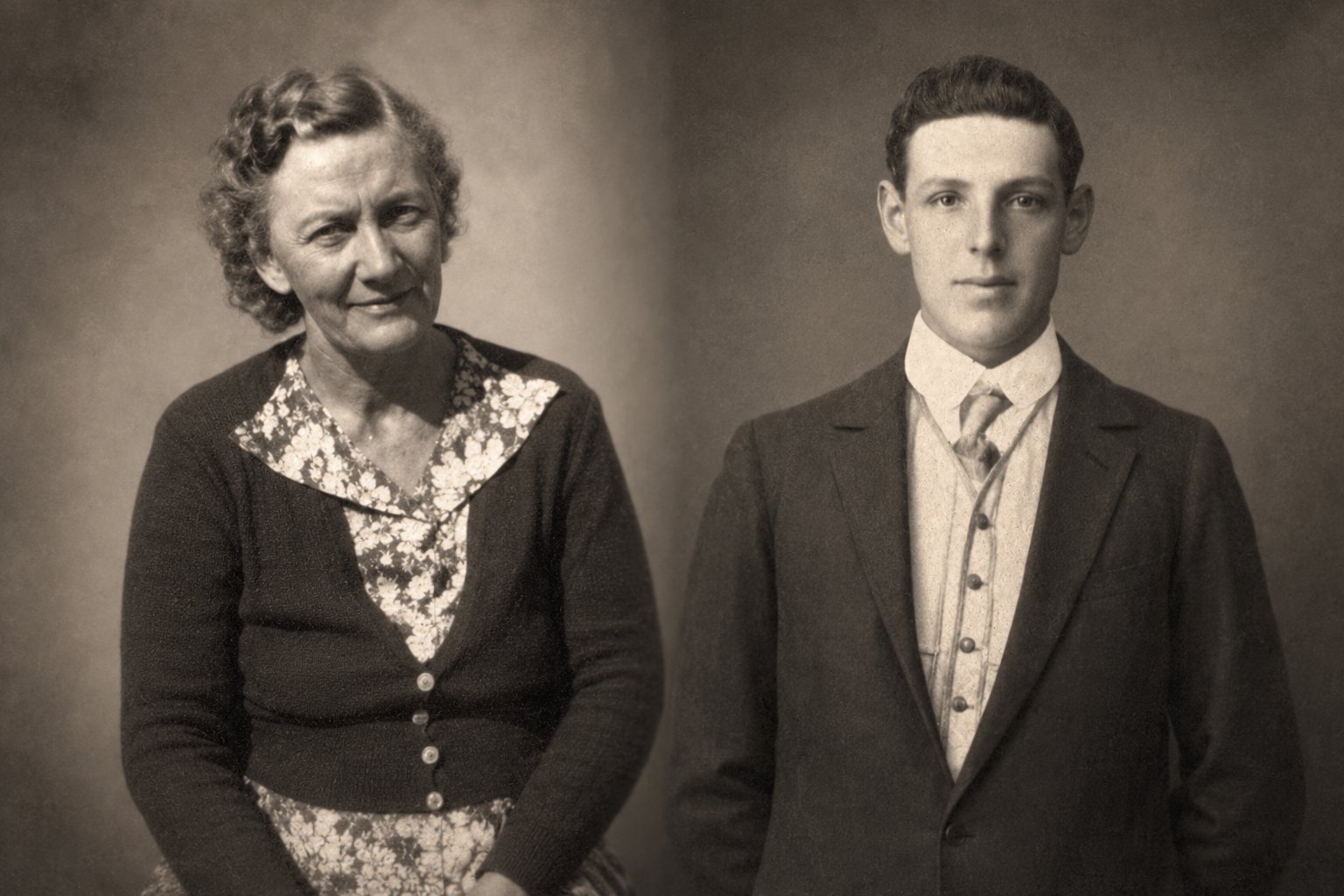
In the port town of Ardrossan on Scotland’s Firth of Clyde, Alexander Shearer and Annie Tyre grew up one street apart - close enough that the backyards touched. He went to sea; she waited. They married in Sydney in 1914, two days after she stepped off the ship. He died in rural New South Wales in 1921, aged thirty-three, his youngest daughter not yet born. She lived on for another fifty-eight years - returning to Scotland, running a store, remarrying, and outlasting them all. This is their story.